


High performance tellurium copper alloy, compliant with ASTM B301 standard, significantly improves cutting performance by adding trace amounts of tellurium element, while maintaining a conductivity of over 90% in the copper matrix. It combines ease of processing and functional reliability, making it an ideal material for precision component manufacturing.
Tellurium Copper Alloy is a special alloy formed by adding 0.4% -0.7% tellurium element to pure copper, just like adding a "smart plugin" to copper. This trace addition allows the material to retain the excellent conductivity of copper (conductivity can reach over 90% of pure copper), while also achieving extraordinary mechanical processing performance. Its unique red copper color is faintly tinged with metallic luster, and the cross-section presents a delicate grain structure.
The tellurium forms fine precipitates (primarily Cu₂Te) within the copper microstructure. These precipitates act as chip breakers during machining, causing swarf to break into short, manageable pieces rather than long, stringy ribbons. This allows for higher machining speeds, lower tool wear, and superior surface finishes
Standard Grades & Specifications
| Designation | Standard | Te Content | Key Features |
|---|---|---|---|
| C14500 | ASTM (USA) | 0.4–0.7% | Most common grade; 85–94% IACS conductivity |
| C109 / CW118C | BS / EN (Europe) | 0.4–0.7% | Equivalent to C14500; ~94% IACS |
| QTe0.3 / JT118 | Chinese (GB) | 0.2–0.35% | Slightly lower Te; 85–94% IACS; good arc resistance |
production process
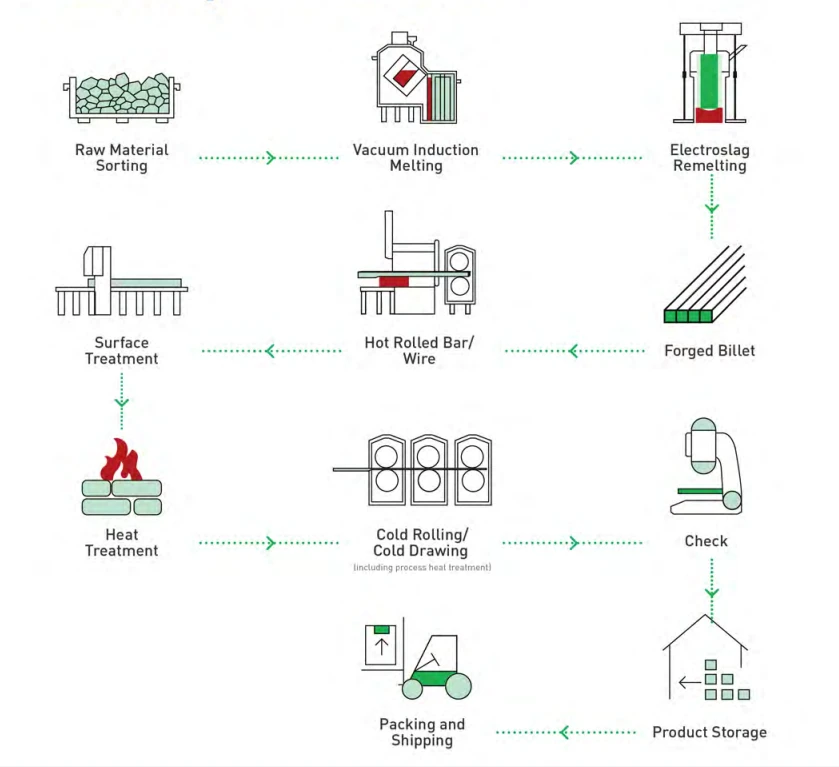
Adopting an integrated process of vacuum melting continuous casting precision rolling:
- Melting: High purity cathode copper is melted with tellurium and deoxidizer in a vacuum furnace to reduce oxidation inclusions;
- Casting: Continuous casting into billets, with grain refinement controlled to below 50 μ m;
- Rolling: Multi pass cold rolling combined with intermediate annealing, precise control of hard/soft properties;
- Surface treatment: acid pickling, polishing or coating to meet different working conditions.
Chemical composition and process characteristics
Core components: Copper (Cu) is used as the matrix (content ≥ 99.2%), with 0.4% -0.7% tellurium (Te) and 0.004% -0.012% phosphorus (P) added. Some models contain trace amounts of zinc (Zn) or iron (Fe). Compliant with ASTM B301/B301M-13 standards, corresponding to Chinese national standard QTe0.5, Japanese JIS C1450, etc.
Key points of the process: Te element refines grain size, forming dispersed second phase particles (such as CuTe), significantly improving cutting performance; Deoxygenation of phosphorus element and enhancement of welding performance; Control oxygen content ≤ 10ppm through vacuum melting and zone technology to avoid the risk of hydrogen embrittlement. The surface can be electrochemically polished to Ra<15nm, with excellent corrosion resistance.
Physical and mechanical properties
Conductivity/Thermal Conductivity: Conductivity of 93% -98% IACS (close to pure copper level), thermal conductivity of about 355 W/(m · K), low high-frequency signal transmission loss, outstanding arc resistance performance.
Mechanical properties: Soft tensile strength of 350-380 MPa, yield strength of 330-370 MPa, elongation of 8% -12%, hardness of HV 120. After cold working, the strength can be increased to over 400 MPa, and the fatigue limit reaches 105 MPa (10 ⁷ cycles).
Processing characteristics: The cutting performance is superior to brass (with a turning performance score of 85 and a free cutting brass score of 100), and it can draw ultra-fine wires with a diameter of 0.015mm. The deep drawing limit ratio (LDR) reaches 2.05, making it suitable for precision stamping, stretching, welding, and forging.
Choose Suggestions
Priority should be given to C14520 tellurium copper: for scenarios with high requirements for cutting processability, conductivity, and arc resistance, such as precision connectors, new energy vehicle charging components, and high-frequency electronic devices. Its excellent cutting performance and conductivity are used in precision manufacturing.
Alternative solution
- C10200 oxygen free copper: a scenario that requires extremely high conductivity (such as superconducting cables) and low cost sensitivity.
- C1100 tough copper: cost sensitive deep drawn products (such as battery cases), but need to avoid high-temperature reducing environments.
- C1220 phosphorus deoxidized copper: refrigeration systems, chemical equipment (with better corrosion resistance and slightly lower conductivity).
Summary: C14520 tellurium copper alloy has become a core material in precision electronics, automotive electrical, and industrial fields due to its high conductivity, excellent machinability, and corrosion resistance. When making a selection, it is necessary to comprehensively evaluate the cost, performance requirements, and environmental conditions of the specific scenario, balancing conductivity, processability, and economy.
Key Features
- Excellent cutting performance: Tellurium element forms a brittle phase, reducing tool wear by 30% and improving machining efficiency by 40%;
- High conductivity and thermal conductivity: conductivity ≥ 85% IACS, suitable for high current scenarios;
- Corrosion and fatigue resistance: Through salt spray testing for ≥ 72 hours, the service life under cyclic loading is better than that of ordinary copper materials;
- Flexible Forming: Supports various processing methods such as stamping, turning, forging, etc.
Test Equipment

Applications
- Electrical and electronic: high-frequency connectors, switch components, motor contacts, IGBT module heat dissipation substrates, semiconductor lead frames, charging gun terminals, and power connectors (especially suitable for high current scenarios in new energy vehicles).
- Automotive industry: Contact materials for electric vehicle charging stations, engine motor contacts, sensors, and precision electronic control units.
- Industrial field: plumbing fittings, heat exchangers, corrosion-resistant components for chemical equipment, plasma cutting accessories, and precision instrument parts.
- Emerging fields: 5G base station high-frequency connectors, high-speed railway electrical components, aerospace arc resistant components.

FAQ
Q1: What are the main components of copper tellurium?
A: Tellurium copper usually contains more than 99% copper (Cu), tellurium (Te) 0.4-0.7%, some models add phosphorus (P) to improve the deoxidation effect.
Q2: Does the electrical conductivity of copper tellurium decrease due to processing?
A: Through the precise temperature-controlled thermal treatment process, copper tellurium can recover more than 95% conductivity after cold processing to ensure stable performance.
Q3: What surface treatments is tellurium copper suitable for?
A: Support silver plating, nickel plating, passivation and other processing, it is recommended to degreasing and pickling before pretreatment to improve adhesion.
Q4: How to distinguish copper tellurium from copper chromium zirconium?
A: Tellurium copper has better cutting ability and lower cost, while chromium zirconium copper (CuCrZr) focuses on high-strength wear resistance scenarios.
Q5: What is the corrosion resistance of copper tellurium?
A: Corrosion resistance in conventional industrial environment is better than pure copper, but strong acid and alkali environment is recommended to use with surface coating.
Q6: What parameters are required when ordering copper tellurium?
A: It is necessary to specify the alloy grade (such as C14500), state (hard/semi-hard), dimensional tolerance and testing standard (ASTM/GB).
Hot Tags: high conductivity tellurium copper alloy, China high conductivity tellurium copper alloy manufacturers


