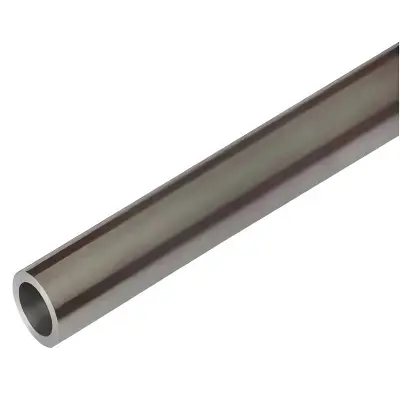
What ASTM F15 Kovar alloy precision solid bar solves - in one sentence: if you are designing electronic packages that require a hermetic glass-to-metal seal, and the seal keeps cracking during thermal cycling, the problem is usually the thermal expansion mismatch between the metal and the glass. Kovar (ASTM F15, UNS K94610) is the controlled-expansion alloy whose CTE is engineered to match borosilicate glass and alumina ceramic, eliminating this mismatch.
Kovar alloy (UNS K94610, ASTM F15) is a nickel-iron-cobalt controlled-expansion alloy containing approximately 29% nickel, 17% cobalt, and balance iron. Its coefficient of thermal expansion (CTE) is designed to match borosilicate (Pyrex) glass and alumina ceramics across the critical sealing temperature range.
The key performance advantage: Kovar's CTE of approximately 4.6–5.2 × 10⁻⁶/°C (30–400°C) closely matches hard glass and alumina ceramic, ensuring high-integrity glass-to-metal and ceramic-to-metal seals that resist thermal shock and maintain hermeticity over the life of the device.
As a China supplier, we provide custom diameters, fast delivery, and MTC certification. Every shipment includes a Mill Test Certificate documenting chemical composition and mechanical properties to ASTM F15.Our Kovar solid bar features tightly controlled chemical composition, consistent thermal expansion coefficient, fine uniform microstructure and ultra‑clean surface condition. Strict dimensional tolerances are achievable for downstream turning, milling and CNC machining.
Key Specifications
Chemical Composition (ASTM F15, wt.%)
| Element | Content |
|---|---|
| Ni | 28.5–29.5 |
| Co | 16.8–17.8 |
| Fe | Balance |
| C | ≤0.04 |
| Mn | ≤0.50 |
| Si | ≤0.30 |
| P | ≤0.020 |
| S | ≤0.020 |
Thermal Expansion (Typical)
| Temperature Range | CTE |
|---|---|
| 30–400°C | 4.6–5.2 × 10⁻⁶/°C |
| 30–450°C | 5.1–5.5 × 10⁻⁶/°C |
Mechanical Properties (Annealed)
| Property | Value |
|---|---|
| Tensile Strength | ~520 MPa (75 ksi) |
| Yield Strength | ~340 MPa (49 ksi) |
| Elongation | ~42% |
| Hardness | ~80 HRB |
| Elastic Modulus | ~138–207 GPa |
Physical Properties
| Property | Value |
|---|---|
| Density | 8.25–8.36 g/cm³ |
| Melting Point | ~1450°C |
| Curie Temperature | ~435°C |
| Thermal Conductivity | ~17 W/(m·K) |
| Electrical Resistivity | ~49 μΩ·cm |
Available Forms & Customization Options
We supply ASTM F15 Kovar Alloy in a wide range of forms and custom sizes:
| Form | Available Options |
|---|---|
| Round Bars | Diameter 2.0 mm – 100 mm, length up to 6,000 mm |
| Precision Ground Bars | Tight tolerances, smooth surface finish |
| Rods & Wires | Custom diameters for lead-outs and pins |
| Strips & Sheets | Custom thickness and width for stamping |
| Tubes & Pipes | Custom OD, ID, wall thickness |
| Custom Components | Machined parts per customer drawings |
| Other Forms | Hexagonal bars, square bars, flanges, forgings |
How to Select Kovar Alloy Based On Your Application Scenarios
Selecting the right Kovar bar depends on your sealing medium, operating temperature and final assembly requirement:
- Glass-to-Metal Hermetic Seal (Hard Borosilicate Glass) Choose standard UNS K94610 ASTM F15 Kovar. Its thermal expansion closely matches hard glass, avoiding seal cracking during brazing and thermal cycling. Typical parts: feedthroughs, transistor housings, vacuum tube components.
- Ceramic Sealing Packages Verify ceramic expansion curve first. In some cases, Kovar works; for low-expansion ceramics, you may consider alternative low expansion alloys.
- Low-Temperature / Mild Thermal Cycle Components If your working temperature range is narrow and glass sealing is not required, Invar 36 may be an equivalent alternative for dimensional stability.
- High-Temperature Service Above 450℃ Kovar's expansion rises sharply at high temperature. We recommend evaluating Nickel-based alloys such asInconel 718 for high-temperature sealing environments.
To dive deeper into real‑world deployment of this material, read our technical article:4J29 Kovar Alloy Applications in Semiconductor Hermetic Packaging, where we cover material characteristics, typical components and critical purchasing considerations for semiconductor‑grade Kovar.
What Kovar Solves for Your Component
Problem 1: Glass-to-metal seal cracking during thermal cycling.
The most common failure mode in hermetic seals is cracking caused by CTE mismatch. Kovar's CTE is engineered to match borosilicate glass and alumina ceramic, minimizing sealing stress and preventing cracking during thermal cycling.
Problem 2: Need for reliable hermeticity in electronic packages.
Kovar is used for glass-to-metal seals in applications requiring high reliability or resistance to thermal shock. It is the standard material for transistor leads and headers, integrated-circuit lead frames, and photography flash bulbs.
Problem 3: Components requiring stable dimensions after sealing.
Kovar's Curie temperature of ~435°C is well above typical sealing and operating temperatures, ensuring that the CTE remains stable and predictable throughout the device's service life.
Problem 4: Custom sizes for specific package designs.
We provide custom diameters and lengths per your drawing. Whether you need a specific diameter for header pins or a custom length for lead frames, we can match your specification.
Key Purchasing Considerations for Kovar Alloy Solid Bar
From a buyer's perspective, these points help you avoid quality risks and project delays:
- Confirm Required Standard: ASTM F15 vs GB/T 4J29 Many projects require ASTM F15 with full EN 10204 3.1 material test certificate (MTC). If your end customer is US/EU semiconductor, specify ASTM F15 + UNS K94610 instead of only 4J29.
- Diameter Tolerance & Surface Finish General stock bar: hot rolled / peeled. Precision application needs ground surface, tight diameter tolerance and straightness control. Specify grinding requirement in RFQ.
- Cut-to-Length & Edge Condition Precision machining parts require square cut, burr-free ends. Long lengths for secondary forging can keep rough cut. Clearly mark cut requirements.
- Thermal Expansion Test Report Hermetic sealing failure is often caused by inconsistent expansion. Ask supplier to provide thermal expansion coefficient test certificate for critical sealing projects.
- Traceability For aerospace and medical components, melt traceability is mandatory. Confirm each batch can be tracked with heat number.
- Lead Time Planning Stock sizes ship fast. Custom diameter, grinding and special inspection will extend lead time. Place orders in advance for tight project schedules.
For semiconductor packaging designers and buyers, explore our in‑depth guide: 4J29 Kovar Alloy (UNS K94610 / ASTM F15) Applications in Semiconductor Hermetic Packaging, Understand why Kovar Alloy solves hermetic‑sealing failure, key material specifications and buying checklist for high‑reliability electronic packages.
Alternative Alloys for Consideration
| If you need... | Consider... | Key Difference |
|---|---|---|
| Lower cost, soft glass sealing | 4J42 (Alloy 42) | No cobalt, ~15-20% lower cost |
| Ultra-low expansion, dimensional stability | 4J36 (Invar) | NOT for glass sealing |
| Higher strength, similar CTE | Rodar | Alternative US grade |
Delivery & Commercial Terms
| Item | Details |
|---|---|
| MOQ | Small MOQ available; stock sizes: 10kg. Custom machined sizes: 50kg |
| Lead Time | Stock items: 7–10 working days. Custom grinding / special cut: 15–25 working days |
| Payment Terms | 30% T/T deposit + 70% balance before shipment; L/C at sight also accepted |
| FOB Port | FOB Shanghai / FOB Qingdao, China (other ports negotiable) |
| Packaging | Anti-rust paper + wooden case / wooden pallet; moisture-proof packing for sea shipment |
| Certificates | EN 10204 3.1 MTC, Chemical & Mechanical Test Report, Heat Traceability; third-party inspection available upon request |
Key Applications – Where Kovar is the Material of Choice
| Industry | Applications | Why Kovar |
|---|---|---|
| Aerospace & Defense | High-vacuum hermetic seals, space optoelectronic devices, missile guidance systems | Extreme reliability, thermal cycling stability |
| Electronics & Semiconductors | IC packages, transistor and diode housings, power tubes, microwave tubes, integrated circuit lead-outs | CTE match to glass/ceramic packages |
| Optoelectronics | Fiber optic components, laser packages, optical devices | Precision sealing, dimensional stability |
| Automotive | Sensors, electronic control units (ECUs), hermetic packaging | Harsh environment durability |
| Telecommunications | RF and microwave components, hermetic enclosures | Signal integrity, vacuum sealing |
| Medical Devices | Implantable device housings requiring hermetic seals | Biocompatibility, hermeticity |
| Scientific Instruments | X-ray tubes, vacuum valves, cryogenic equipment | Low-temperature stability |
About Us
We are a professional Chinese manufacturer and supplier of ASTM F15 Kovar Alloy (UNS K94610 / 4J29). We specialize in high-precision solid bars, rods, strips, wires and custom-machined components engineered for glass-to-metal hermetic sealing. Our materials serve the electronics, semiconductor, aerospace, telecommunications and medical device industries worldwide
.
We adopt vacuum induction melting (VIM) and vacuum arc remelting (VAR) production processes. Our products strictly comply with international specifications including ASTM F15, GB/T 15018 and MIL‑I‑23011, with full material traceability and Mill Test Certificates (MTC) supplied for every shipment.
Our engineering team masters coefficient of thermal expansion (CTE) matching. Our Kovar alloy features a CTE of 4.6–5.2 × 10⁻⁶/°C (30–400°C), closely matched to hard borosilicate glass and ceramics to create stable, stress-free hermetic seals.
We offer global export services with flexible MOQs, dependable lead times and end-to-end technical support. We assist customers with material selection, sealing process optimization and total cost reduction. Partner with us for consistent, high-quality controlled-expansion alloy solutions with competitive pricing and stable global supply.
Our Factory

Vacuum Melting Furnace

Automatic Cold Drawing Line For Expansion Alloy Bars

Solution Annealing Furnace

4-Tensile Testing Machine

Flaw Detector

Hardness Tester
Why Choose Us - China Supplier With MTC Certification
1. MTC certified with every shipment. Every shipment includes a Mill Test Certificate (MTC) with chemical composition and mechanical properties verified to ASTM F15.
2. Custom sizes cut to your drawing. Diameter and length per your specification. No wasted material.
3. Fast delivery from stock. Standard sizes ship in 7–15 days; custom sizes confirmed at order review.
4. Technical support for sealing applications. Our team can advise on pre-oxidation treatment, sealing parameters, and heat treatment cycles for your specific glass or ceramic system.
5. Competitive pricing from China. Direct factory supply with flexible MOQ for trial orders.
Need Custom ASTM F15 Kovar Alloy Precision Solid Bar?
Tell us your required diameter, length, quantity, and application (glass sealing, electronic component, etc.). We will confirm availability, provide a quotation, and ship with full documentation.
FAQ
Q1: What is ASTM F15 Kovar alloy precision solid bar used for?
A: Kovar alloy bar (UNS K94610, ASTM F15) is used for glass-to-metal seals in electronic applications, including transistor leads and headers, integrated-circuit lead frames, hybrid circuit casings, power tubes, microwave tubes, and optoelectronic component packages.
Q2: What is the difference between Kovar and Alloy 42?
A: Kovar is a Fe-29Ni-17Co alloy with a CTE that matches borosilicate glass and alumina ceramic. Alloy 42 is a Fe-42Ni binary alloy with a lower CTE that matches silicon and certain ceramics, but does not match borosilicate glass as well as Kovar. Choose Kovar for glass-to-metal seals; choose Alloy 42 for silicon-matching or ceramic sealing where glass is not involved.
Q3: What is the thermal expansion coefficient of Kovar?
A: Kovar's CTE is approximately 4.6–5.2 × 10⁻⁶/°C (30–400°C) and 5.1–5.5 × 10⁻⁶/°C (30–450°C). This matches borosilicate (Pyrex) glass and alumina ceramic.
Q4: What is the Curie temperature of Kovar?
A: Kovar's Curie temperature is approximately 435°C. This is well above typical sealing and operating temperatures, ensuring stable CTE behavior.
Q5: What glass and ceramic does Kovar match?
A: Kovar matches borosilicate (Pyrex) glass and alumina ceramic. These are the standard materials for glass-to-metal and ceramic-to-metal sealing applications.
Q6: Can Kovar bar be machined and formed?
A: Yes. Kovar can be machined, turned, milled, and drilled. It can also be formed and deep drawn from the annealed temper. A 1/8 hard temper is optimum for heavy piercing.
Q7: Can Kovar be welded?
A: Yes. Kovar can be joined to other metals by welding, brazing, and soldering. The joint design must account for Kovar's lower expansion coefficient compared to most other metals.
Q8: What industries and scenarios is Kovar Alloy suitable for?
A: Professional for high-precision hermetic packaging scenarios. Widely used in semiconductor packaging, electronic feedthroughs, vacuum equipment components, aerospace sensors, telecommunication devices and medical device hermetic assemblies, perfectly adapting to all glass-to-metal and ceramic-metal sealing working conditions.
Q9: What is the Chinese equivalent of Kovar?
A: The Chinese equivalent is 4J29. The German equivalent is W.Nr 1.3981. These are direct equivalents.
Q10: Can Kovar bar be used for ceramic sealing?
A: It depends on the thermal expansion of your ceramic material. Kovar is ideal for hard borosilicate glass sealing. For ceramic packages, please send us your ceramic expansion data so we can recommend the suitable alloy.
Q10: How do I avoid procurement pitfalls when buying Kovar bar?
A: Key checks:
- Verify the grade - confirm UNS K94610 / ASTM F15 equivalence.
- Confirm Ni and Co content - Ni 28.5–29.5%, Co 16.8–17.8%.
- Request measured CTE data - datasheet values are typical; measured values are required for critical sealing applications.
- Confirm the supply condition - annealed condition for stable expansion.
- Check dimensions and tolerance - verify against your drawing.
- Request the Mill Test Certificate (MTC) - confirm compliance to ASTM F15.
- Request PMI verification - confirms material authenticity.
Q11: What is the one-line rule for choosing Kovar?
A: Choose ASTM F15 Kovar alloy precision solid bar when you need a hermetic glass-to-metal or ceramic-to-metal seal with a CTE matched to borosilicate glass or alumina ceramic. For CTE matching to silicon, consider Alloy 42 instead.
Hot Tags: ASTM F15 Kovar solid bar, UNS K94610 kovar alloy bar, Kovar precision solid bar, Kovar alloy for electronic hermetic packaging, custom Kovar bar, Kovar alloy bar China supplier