


Electrolytic copper foil serves as the primary anode current collector in lithium-ion batteries, providing an electrically conductive pathway for electron transfer and a stable substrate for anode active-material coating. Its mechanical strength, surface roughness, oxidation resistance, and dimensional consistency directly influence electrode processing quality, interfacial contact, and long-term battery performance.
Selecting the right copper foil involves more than choosing a thickness. Battery manufacturers must also consider mechanical properties, surface characteristics, and compatibility with different anode chemistries. Understanding the differences between bare electrolytic copper foil and carbon-coated copper foil is particularly important for advanced battery designs. For applications involving high-expansion anode materials, explore our comparative guide: Carbon-Coated Copper Foil vs. Bare Copper Foil: How Surface Modification Improves Battery Performance. For cathode-side current collector solutions, discover our Carbon-Coated Aluminum Foil.
Technical Specification
| Item | Specification Details |
|---|---|
| Nominal Thickness | 4μm, 4.5μm, 5μm, 6μm |
| Unit‑Area Mass(g/m²) | 35.5±2.0(4μm); 40.0±2.0(4.5μm); 44.5±2.0(5μm); 53.5±2.0(6μm) |
| Tensile Strength(kgf/mm², room temperature) | 50.0‑60.0 |
| Elongation(%, room temperature) | ≥3.0(4μm); ≥3.5(4.5μm); ≥4.0(5μm); ≥5.0(6μm) |
| Surface Roughness | Shiny side Ra ≤0.3μm; Matte side Rz ≤3.0μm |
| Gloss(Gs) | 50‑400 |
| Thickness Tolerance(μm) | (‑0/+2) |
| Width Tolerance(mm) | ±1 |
| Wettability(mN/m) | ≥38 |
| Anti‑oxidation Performance | No obvious discoloration or oxidation after baking at 150℃±2℃ for 10 min |
| Copper Purity | Cu ≥99.8% |
| Defect Control | Clean cutting edge; no crease, crack, tension wrinkle; uniform color; free of oxidation, spot, corrosion, dirt; allow qualified minor processing streaks without affecting slurry coating |
| Splice Joint | ≤1 joint per roll |
| Compliance | RoHS, REACH regulation requirements; third‑party annual hazardous‑substance inspection available |
| Shelf‑life | 60‑90 days under qualified storage; store under relative humidity ≤65% RH, 5‑25℃ environment, away from corrosive chemicals & moisture |
👉 Request a 4-6μm Copper Foil Sample for Test
Product Classification & Differences for Lithium‑Ion Battery Application
| Copper Foil Type | Core Production Characteristic | Suitable Lithium‑ion‑Battery Scenarios | Not Recommended For |
|---|---|---|---|
| Double‑Sided Shiny High‑Strength ED Copper Foil | Both‑side smooth surface; high tensile strength 50‑60 kgf/mm²; stable elongation; tight thickness tolerance | Energy‑storage lithium‑ion batteries, automotive power batteries, 3C consumer batteries; mass‑production high‑speed coating & winding process | Silicon‑carbon anode cells with severe interface‑peeling risk without surface modification |
| Single‑Sided Matte / Shiny‑Matte ED Copper Foil | One smooth shiny side, one matte rough side; enhanced physical anchoring for slurry | Mid‑low‑load graphite‑anode consumer cells; lab prototype cells | Ultra‑high‑energy‑density mass‑production cells requiring uniform double‑side coating |
Which Current Collector Do You Need?
While this double-shiny copper foil is the ultimate baseline, different anode systems demand different surface engineering. Use this matrix to select the right foil for your cell:
| Your Battery / Anode Design | Recommended Foil | Why? (The Engineering Reality) |
|---|---|---|
|
Standard Graphite / Si-C (Requires strong adhesion & low DCR) |
👉 Carbon Coated Copper Foil | Adds a 0.5-2μm conductive carbon layer. Slashes interfacial resistance and prevents powder shedding in high-silicon anodes. |
| High-Silicon Anodes / Extreme Fast Charging (Requires 3D structure) | 👉 Microporous Copper Foil | Creates a 3D physical scaffold with through-holes. Drastically improves wetting and anchors silicon expansion. |
|
Standard EV & ESS Cells (Cost-sensitive, moderate rates) |
👉 High-Strength Double-Shiny Cu Foil (This Product) | The reliable baseline. 50-60 kgf/mm² tensile strength prevents web breakage at 4.5-6μm without the premium of carbon coating. |
Upgrading your interface? Explore our Carbon Coated Copper Foil for Anodes or our Microporous Copper Foil.
Why Choose HSMetal?
Verified Anti-Breakage: Our 50-60 kgf/mm² tensile strength is verified per lot. We provide MTC data to prove it.
Custom Slitting: We deliver exact widths (with ±1mm precision) with burr-free edges to prevent die wear and edge-tearing on your coater.
Fast Sampling: We offer free sample rolls (typically 10-50 meters) so your engineers can run a full coating trial before committing.
Honest Boundary: If your graphite anode requires lower DCR, we will tell you to buy our Carbon Coated Copper Foil instead of this bare foil.
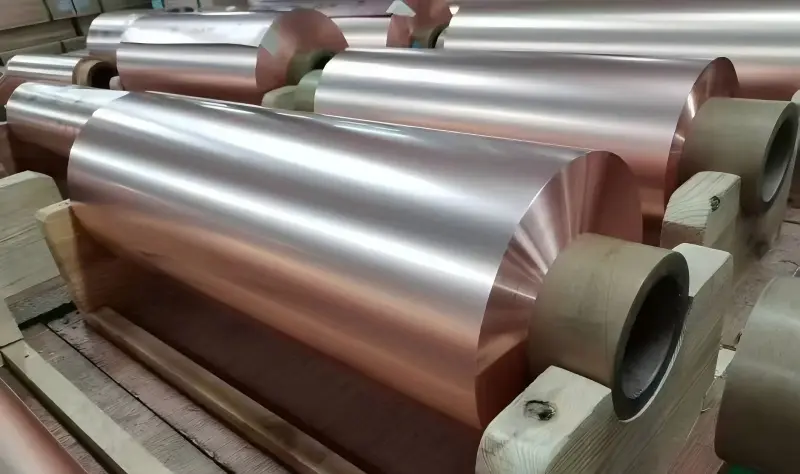
Application Fields for Lithium‑Ion‑Battery Copper Foil
EV Power Batteries: Ultra-thin 4.5μm/5μm foil provides higher energy density while maintaining mechanical stability.
Energy Storage Systems (ESS): 6μm foil offers robust cycle stability and cost-efficiency.
3C Digital Batteries: 4μm foil is ideal for highly compact, high-capacity smartphones and wearables.
Silicon-Carbon Anodes: The high tensile strength (50-60 kgf/mm²) resists the severe volume expansion that tears weaker foils.
👉Contact HSMetal for a 24-Hour Custom Quote
Commercial And Delivery Term
| Term | Details |
|---|---|
| MOQ | 200kg; small trial order & sample roll support |
| Lead Time | Standard stock sizes: 7-10 days; custom slitting, Customized order:15-25 days |
| Export Packing | Inner plastic‑film moisture‑proof package, pearl‑cotton buffer, fixed in wooden export crates. Mark product specification, roll number, net/gross weight, RoHS mark and manufacturer information on outer package |
| Shipping | Global export by sea freight, air freight or courier service |
| Documents | Mill Test Certificate(MTC), packing list, commercial invoice, batch traceability documents, RoHS / REACH test report as requested |
| Payment | Terms mutually confirmed before formal order placement |
Request a Quote for Lithium-Ion Battery Copper Foil
Looking for a reliable supplier of ultra-thin electrolytic copper foil for lithium-ion battery manufacturing?
HSMetal offers 4μm, 4.5μm, 5μm, and 6μm double-sided bright copper foil for battery anode current collectors.Whether you are sourcing materials for EV batteries, energy storage systems, or consumer electronics, our team is ready to discuss your technical requirements.
Our team will ship a free sample roll for your coating line, backed by full MTC and RoHS reports.
👉 Request a Sample Roll of 4-6μm High-Strength Foil and Quotation
👉 Explore Our Carbon-Coated Copper Foil for Anodes
FAQ
Q1: What type of copper foil is used in lithium-ion batteries?
A: Electrolytic copper foil is widely used as the negative electrode current collector in lithium-ion batteries. It supports the anode coating and provides an electrically conductive pathway for electron collection.
Q2: What thickness of copper foil is used for lithium-ion battery anodes?
A: Common battery copper foil specifications include 4.5μm, 6μm, 8μm and other thicknesses. HSMetal offers 4μm, 4.5μm, 5μm and 6μm options. The appropriate thickness depends on battery design, mechanical requirements, and manufacturing conditions.
Q3: Why is ultra-thin copper foil used in lithium-ion batteries?
A: Ultra-thin copper foil helps reduce the weight of the negative electrode current collector, creating opportunities to optimize battery gravimetric energy density. Its selection must also consider mechanical strength and production stability.
Q4: What is the difference between electrolytic copper foil and rolled copper foil?
A: Electrolytic copper foil is manufactured through electrodeposition, while rolled copper foil is produced through mechanical rolling and annealing. They have different grain structures and mechanical characteristics and should be selected according to application requirements.
Q5: Can conventional copper foil be used for silicon-based anodes?
A: Conventional copper foil can be evaluated for silicon-containing anode systems. However, silicon expansion and contraction during cycling may increase mechanical stress at the electrode-current collector interface. Surface properties, electrode adhesion, and cell performance should be validated.
Q6: What is the difference between bare copper foil and carbon-coated copper foil?
A: Bare copper foil uses the copper surface directly as the interface with the anode coating. Carbon-coated copper foil adds a conductive carbon layer designed to improve interfacial contact, electrode adhesion, and surface protection.
Q7: What is the copper purity of HSMetal battery copper foil?
A: The specified copper content is ≥99.8%, according to the product technical standard.
Q8: What is the tensile strength of HSMetal copper foil?
A: The specified tensile strength is 50–60 kgf/mm² at room temperature, equivalent to approximately 490–588 MPa.
Q9: Is HSMetal copper foil suitable for energy storage and EV batteries?
A: The product is designed for energy storage batteries, automotive power batteries, and 3C digital batteries. Final suitability depends on the battery chemistry and customer manufacturing requirements.
Q10: Can I request a customized copper foil specification?
A: Please contact HSMetal with your required thickness, width, roll dimensions, anode material, and application. Our team can discuss the available specifications and technical requirements.
Q11: What is the difference between "double-shiny" and regular copper foil?
A: Double-shiny (or dual-smooth) copper foil has a highly polished, smooth surface on both sides. This provides a uniform Ra ≤ 0.3μm on the shiny side, which ensures excellent coating uniformity for high-density, thin-film electrodes.
Q12: Why is tensile strength (50-60 kgf/mm²) critical for 4.5μm foil?
A: At 4.5μm or 4μm, the foil is exceptionally thin. If the tensile strength is lower than 50 kgf/mm², the foil will easily tear under the tension of high-speed coating, calendering, and winding, leading to catastrophic yield loss. Our 50-60 kgf/mm² ensures web stability.
Q13: Can I get a sample of the 4.5μm foil for a coating trial?
A: Yes. We strongly encourage sampling. We can provide a short sample roll (e.g., 50 meters) of the 4.5μm or 6μm foil so your team can test the anti-breakage performance on your actual coater.
Q14: What is the shelf life of your copper foil?
A: The shelf life is 150 days from the production date (if kept under ≤25°C and ≤65% RH in original packaging). To ensure freshness, we hold strict inventory rotation and ship directly from our cleanroom packaging.
Q15: Does this foil pass RoHS and REACH?
A: Yes. Our copper foil meets Cu ≥ 99.8% purity, and we conduct annual third-party testing for RoHS and REACH compliance. The MTC and test reports are provided with every shipment.
Hot Tags: Copper Foil for Lithium Ion Battery Current Collector, 4um copper foil, high strength copper foil, double shiny copper foil, battery grade copper foil, ultra thin copper foil supplier, HSMetal


