


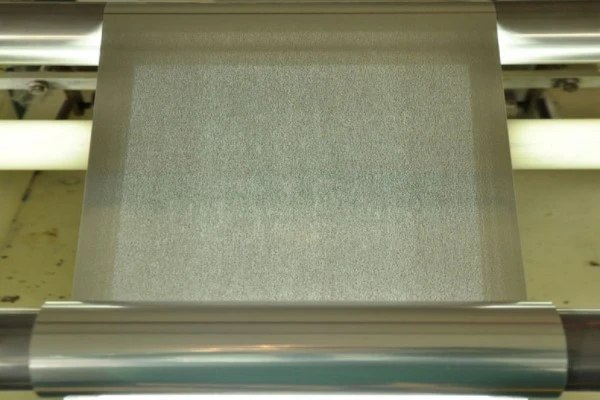

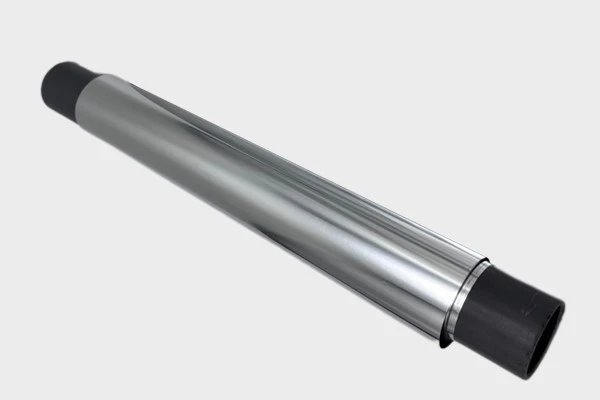
Conventional aluminium foil forces lithium ions to travel a two-dimensional path along the plane of the current collector toward the tab. That geometry limits rate capability, slows electrolyte wetting, and leaves the adhesion between active material and foil dependent on surface roughness alone. Microporous Aluminum Foil changes the transport geometry. Through-pores-typically distributed from 200 to 3,000 per unit area with pore sizes ranging from 5 to 50 μm-allow lithium ions to migrate in three dimensions, through the foil rather than only along it. Active material fills the pores, creating an "H"-shaped mechanical interlock between the front and back electrode coatings that dramatically reduces the probability of delamination.
Independent research on electrolytically etched microporous aluminium and copper foil pairs confirms the performance impact: microporous current collectors delivered better rate performance and lower electrochemical impedance than conventional foil in ultra-high-rate full cells, with capacity retention at 10C reaching 76.96% for microporous systems versus 62.43% for conventional foil after 500 cycles . The micropore structure also provides stress-release space for electrode volume expansion and improves safety performance by redistributing current density at the interface .
If you are sourcing anode-side porous current collector for matching cell design, check our microporous copper foil for anode. Pair our microporous aluminum foil (cathode) with microporous copper foil (anode) to build full high-rate porous current collector system for pouch, cylindrical and solid-state cells.
Product Specifications
|
Size |
Micropore Index |
Microporous distribution structure |
Decrease In Areal Density |
Properties |
|||||||
|
Width |
Thichness |
Micropore Density |
Micropore Diameter |
Tensile Strength |
Decrease |
Elongation |
Reduction |
resistivity |
Increase |
||
|
200-1000 |
0.01-0.025 |
200-499 |
5-50 |
Full Surface |
0.01-1 |
≥160 |
|
≥1.15 |
≤43 |
≤3.4 |
≤13 |
|
500-799 |
0.01-1.57 |
≥155 |
≤16 |
≥1.05 |
≤48 |
||||||
|
800-1099 |
0.02-2.16 |
≥150 |
≤19 |
≥0.95 |
≤53 |
||||||
|
1100-1399 |
0.02-2.75 |
≥140 |
≤25 |
≥0.85 |
≤58 |
||||||
|
1400-1699 |
0.03-3.33 |
≥130 |
≤30 |
≥0.75 |
≤63 |
||||||
|
1700-1999 |
0.03-3.92 |
≥120 |
≤35 |
≥0.65 |
≤68 |
||||||
|
2000-3000 |
0.04-5.89 |
≥100 |
≤46 |
≥0.5 |
≤75 |
||||||
What Is Microporous Aluminum Foil?
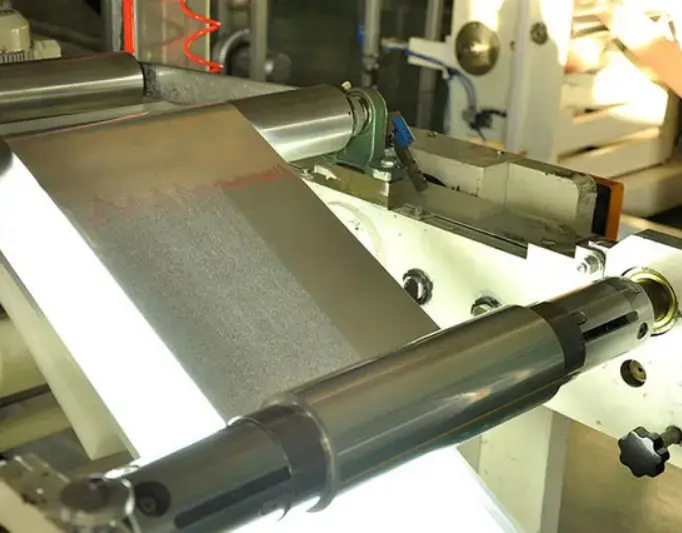
Microporous aluminum foil is a perforated aluminium current collector made by processing conventional aluminium foil to create a designed pattern of through-holes. The base foil continues to provide the metallic current-collecting structure, while the holes introduce a porous geometry into the electrode assembly. In a lithium-ion battery, the electrode coating, current collector, separator, and electrolyte work together as a system. A microporous current collector changes the physical structure of the foil and may influence electrolyte access, the interaction between electrode coatings on opposite faces, and the mechanical anchoring of the electrode layer.
The outcome depends on the pore size, pore density, foil thickness, remaining metal area, electrode formulation, and manufacturing process. A higher pore density is not automatically better: excessive perforation can reduce the remaining load-bearing metal area or affect handling and coating stability. The correct design should balance the intended electrochemical benefit with mechanical integrity and process requirements.
Layout Type of Microporous Aluminum Foil
Our microporous aluminum foil is available in three distinct micropore distribution patterns to meet customized cell designs and tab welding requirements: Edge Blocking Microporous Aluminum Foil (perforated only in the central zone, with solid non‑porous edge margins of width "b" reserved on both sides); Single Cut Edge Blocking Microporous Aluminum Foil (featuring one longitudinal solid non‑porous strip of width "2b" at the center, engineered for center tab welding, alongside non‑porous outer edges); and Multi Cut and Multi Wide Edge Blocking Microporous Aluminum Foil (with multiple central solid strips, optimized for multi‑tab configurations).
All three variants retain non‑porous margins to maintain structural integrity during coating and prevent slurry leakage. The customizable solid blank zones deliver reliable welding spots without compromising the 3D ion transport and interlocking anchoring benefit within the coated active area.

Alternative & Complementary Material Solutions
Microporous aluminium foil is one option in a broader current collector portfolio. The right choice depends on your performance priorities:
- Carbon Coated Aluminium Foil: Surface carbon coating improves adhesion and reduces interfacial resistance without modifying the foil structure. Best for applications where 3D transport is not the bottleneck. See our [Carbon Coated Aluminium Foil Purchasing Guide] for selection criteria.
- Bare Aluminium Foil: For cost-sensitive or low-rate applications where neither surface treatment nor pore structure is justified.
- Microporous Copper Foil: The anode-side counterpart, sharing the same pore-forming technology. For full-cell builds, pairing microporous aluminium and copper foil delivers the 3D transport benefit at both electrodes . See our [Microporous Copper Foil] page.
- Etched Aluminium Foil: Surface roughening without through-pores. Improves adhesion but does not enable 3D ion transport or the "H"-shaped interlock.
If your primary problem is high-rate performance or wetting speed, microporous foil is the structural solution. If your primary problem is interfacial resistance between active material and foil, carbon coating may be sufficient. Many high-performance cell designs ultimately use both: microporous structure for transport and wetting, plus carbon coating for adhesion and corrosion protection.
Application Fields
Microporous aluminium foil is deployed where transport geometry and wetting speed matter:
- Fast-charge lithium-ion cells: where 3D ion transport reduces polarization at high rates .
- High-energy-density cathodes: thick or high-loading LFP, NMC, and LCO electrodes where wetting is a production bottleneck.
- Power batteries for EVs: start-stop, regenerative braking, and high-power discharge applications.
- Energy storage systems: where cycle life and consistent wetting across large-format cells are priorities.
- Flexible and thin-film batteries: the pore structure improves electrode flexibility and bendability.
- Next-generation battery R&D: semi-solid and solid-state cell prototyping, where interface engineering and wetting behavior are under active investigation.
- Supercapacitor electrodes: where rapid electrolyte access to high-surface-area active material is critical.
For anode-side applications in the same cells, pair with our [Microporous Copper Foil] . For cathode designs where carbon coating rather than pore structure is the primary interface solution, see our [Carbon Coated Aluminium Foil for Supercapacitor] page.
About Us
We are a specialized manufacturer of advanced current collector materials for the battery industry, supplying microporous aluminum foil alongside microporous copper foil and carbon-coated foils for lithium-ion, sodium-ion, and supercapacitor applications. Our pore-forming technology is designed as a true drop-in solution-enabling 3D ion transport, rapid electrolyte wetting, and "H"-shaped electrode interlocking without requiring any changes to your existing coating, calendering, or assembly equipment.
By offering customizable pore densities, edge-blocking patterns for tab welding, and substrate thicknesses from 10 to 25 μm, we help battery engineers optimize both energy density and high-rate performance. Every roll is backed by rigorous inspection data covering pore distribution, tensile strength, and dimensional accuracy, and our team supports your scale-up from R&D prototyping to mass production.
Whether you are building high-power EV cells, large-format energy storage systems, or next-generation solid-state batteries, we focus on one thing: engineering the current collector interface for maximum cell efficiency. Contact our technical team to discuss your next build.
Our Factory
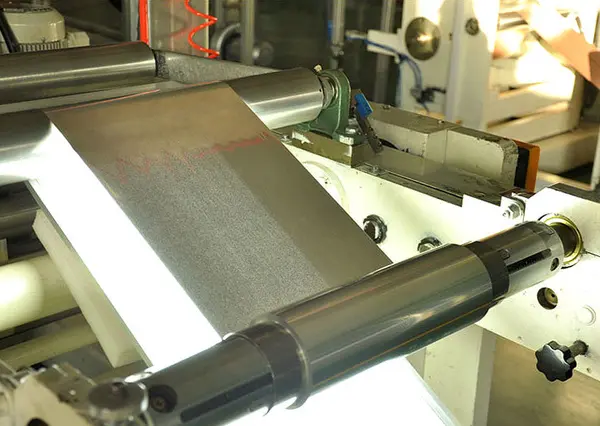
Precision Roll-to-Roll Production
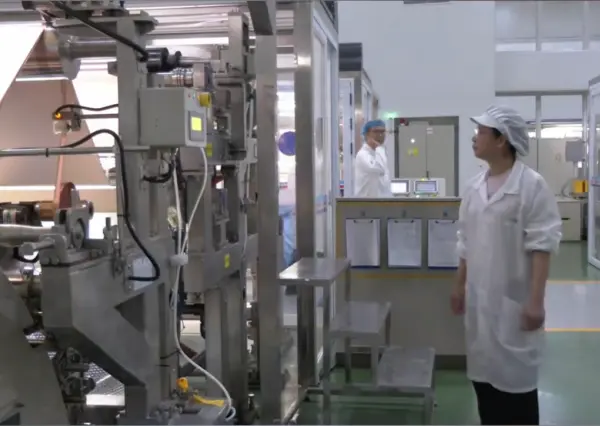
Strict Shop-Floor Supervision

Rigorous R&D and Quality Inspection
Request a Quote for Microporous Aluminum Foil
Ready to evaluate microporous aluminum foil on your coating line? Send us your electrode type (LFP, NMC, LCO, supercapacitor), target rate capability, and current foil specification. Our technical team will recommend the appropriate WHL series, provide a sample roll for your equipment validation, and respond within 24 hours.
Request a Sample → [Contact Sales]
Looking for porous current collector for anode matching? Check our Microporous Copper Foil, designed for lithium battery anode, fast charging, lithium metal anode and solid-state battery projects. Combine microporous aluminum foil (cathode) + microporous copper foil (anode) to realize systematic promotion of battery rate and cycle life.
FAQ
Q1: What is microporous aluminum foil?
A: Microporous aluminum foil is aluminium current collector foil with a designed pattern of through-holes. It is evaluated for battery applications where the porous structure may support electrolyte access, electrode-layer interaction, or current collector weight optimization.
Q2: What are the main applications of microporous aluminum foil?
A: It is primarily considered for compatible lithium-ion battery cathode current collectors, battery R&D, pilot production, and selected energy-storage applications. Suitability depends on the electrode chemistry and cell design.
Q3: What is the difference between single-side and double-side coating on microporous foil?
A: The foil itself is compatible with both. Single-side coating is appropriate when your cell design requires a bare backside for welding or when you are evaluating the foil in a simple test format. Double-side coating is where the full benefit appears: the "H"-shaped interlock requires active material on both faces, and the 3D transport benefit is most measurable in a double-coated electrode. For most production applications, double-side coating is the intended configuration.
Q4: A: Can microporous aluminum foil directly replace my existing regular aluminum foil on the production line?
A: It can be compatible with most standard coating and calendaring lines, but the cathode slurry formula, coating loading and rolling pressure may need minor adjustment. We provide technical guidance together with samples. It is strongly recommended to start with coin cell and soft pouch validation first.
Q5: Can microporous aluminum foil improve electrolyte wetting?
A: The openings may provide additional pathways for electrolyte access, potentially improving wetting in a suitable electrode design. Actual performance depends on pore geometry, electrode porosity, electrolyte formulation, and cell construction.
Q6: Can microporous aluminum foil improve battery energy density?
A: Perforations can reduce the mass of the current collector, which may contribute to a lighter electrode structure. However, the net effect on cell-level energy density depends on the remaining metal area, active material loading, mechanical requirements, and full cell design.
Q7: What pore diameters and pore densities are available?
A: These parameters depend on the product design and production capability. Please provide your target pore diameter, hole density, foil thickness, and perforated width so the available specification can be reviewed.
Q8: Can HSMetal customize foil width and perforated areas?
A: Customized width and perforation layouts can be discussed, including edge margins and selected unperforated zones, subject to technical feasibility. A drawing or target specification will help speed up the review.
Q9: What is the difference between microporous aluminum foil and microporous copper foil?
A: Both have perforated structures, but the base metals serve different electrode requirements. Microporous aluminium foil is commonly considered for compatible cathode applications, while microporous copper foil is commonly considered for compatible anode applications. The appropriate material depends on electrode chemistry and cell design.
Q10: Can microporous aluminum foil be used on existing coating equipment?
A: HSMetal's product information states that the foil can be used with existing coating and calendaring processes without changing equipment. Buyers should still conduct process trials to verify web handling, coating uniformity, and compatibility with their specific production line.
Q11: How quickly can customized microporous aluminum foil be delivered?
A: Lead time depends on the requested specification, order quantity, processing requirements, availability, and shipping destination. Share your target delivery date so the schedule can be assessed and confirmed before ordering.
Q12: What information should I provide to request a quotation?
A: Please include the aluminium grade and thickness, pore diameter, pore density, perforated width, total width, edge design, roll format, required quantity, quality criteria, application, and destination.
Q13: A: What is the difference between your microporous aluminum foil and laser perforated aluminum foil?
A: Our foil adopts chemical etching to form dense micron-level interconnected pores without sharp burrs. Laser drilling usually forms isolated large holes, easy to cause foil crack during calendaring and winding, and the cost is much higher.
Q14: A: Can you supply both microporous aluminum foil and microporous copper foil as a matched set?
A: Yes. HSMetal provides cathode-side microporous aluminum foil and anode-side microporous copper foil at the same time. We can coordinate pore parameters for your full-cell R&D and offer combined test reference.
Q15: A: What is the biggest limitation of microporous aluminum foil?
A: Higher porosity will sacrifice partial tensile and elongation. Our engineering team will recommend a balanced porosity range once you share your winding process and C-rate target. We do not pursue maximum porosity blindly.
Q16: What is the difference between microporous aluminum foil and carbon coated aluminum foil?
A: They solve different problems. Carbon coated foil applies a thin conductive carbon layer to improve adhesion and reduce interfacial resistance between the active material and the foil surface. Microporous foil creates through-pores in the foil itself, enabling 3D lithium-ion transport and an "H"-shaped mechanical interlock between front and back coatings. Microporous foil addresses rate capability and wetting speed; carbon coating addresses adhesion and contact resistance. Some high-performance designs use both.
Q17: Does microporous foil reduce mechanical strength?
A: Yes, to a degree. The pore-forming process reduces tensile strength and elongation relative to solid foil. Published data on electrolytically etched aluminium foil shows strength decreasing from ~287 to ~238 MPa and elongation from ~3.16% to ~1.74% . Our WHL series is graded by pore density, so you can select the level of weight reduction and transport benefit that your processing tension and electrode loading can accommodate.
Q18: How does microporous foil improve electrolyte wetting?
A: The through-pores provide direct vertical pathways for electrolyte to penetrate the electrode stack, rather than requiring lateral wicking from the edges. This reduces wetting time and improves consistency across the electrode area. Our customers report wetting efficiency improvements of 50% or more.
Q19: Is microporous foil suitable for silicon anode systems?
A: On the cathode side, the foil is independent of anode chemistry. On the anode side, microporous copper foil is being evaluated for silicon-blend systems where stress release space and improved wetting are valuable. For anode-specific guidance, see our [Microporous Copper Foil] page or contact our technical team.
Hot Tags: microporous aluminum foil, microporous aluminum foil for lithium battery, perforated aluminum foil current collector, 3D current collector aluminum foil, microporous copper foil


