


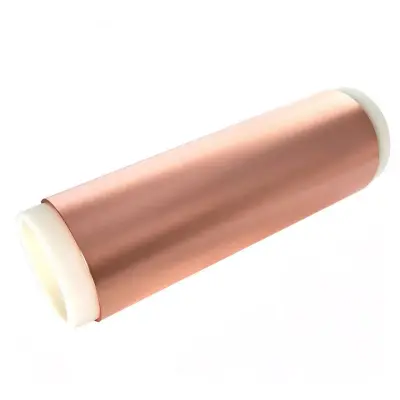
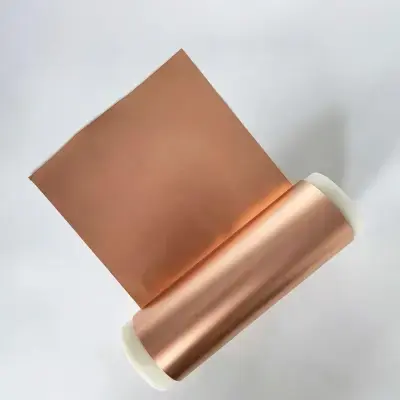
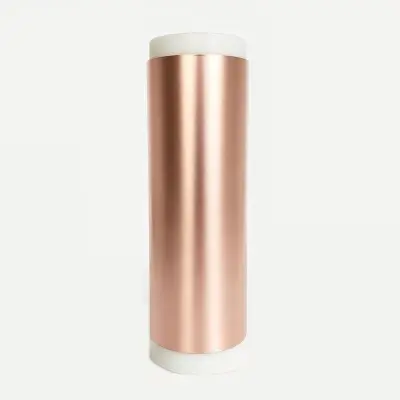


HSMetal manufactures customized Microporous Copper Foil for Anode-Free Sodium Batteries, providing precision-perforated copper foil solutions for advanced battery research, sodium metal deposition studies, and next-generation energy storage technologies.
Our microporous copper foil features a carefully designed perforated structure with customizable pore diameter, hole spacing, foil thickness, open area, and surface characteristics. Compared with conventional flat copper foil, a properly engineered microporous structure can provide additional design flexibility for current collectors and sodium deposition substrates.
In anode-free sodium metal batteries, sodium ions released from the cathode are deposited onto the current collector during charging. The structure and surface properties of the current collector can influence sodium nucleation, deposition distribution, and stripping behavior. HSMetal's Microporous Copper Foil for Anode-Free Sodium Batteries is designed to support research into advanced current collector architectures and optimized sodium metal battery interfaces.
As an experienced microporous metal foil manufacturer, HSMetal provides customized copper foil specifications, precision perforation, optional surface treatment solutions, and responsive delivery services to meet different battery development requirements.
Technical Specifications
| Test Item | Typical Reference Value | Remarks |
|---|---|---|
| Substrate | Copper foil, purity ≥99.9% | Electrodeposited or rolled base |
| Thickness | 10–20 μm | Ultra-thin foam microporous structure |
| Porosity | 80–90% | Volumetric open porosity |
| Pore size (diameter) | 5–20 μm | Adjustable within range |
| Pore density | ~5,000–8,000 pores/cm² | Depends on pore size and porosity target |
| Tensile strength | 200–300 MPa (typical, porous) | Verify against your winding tension |
| Elongation | ≥ 1.5–2.5% | Porous structure reduces ductility vs. dense foil |
| Surface roughness (Ra) | ≤ 0.4 μm (smooth side) | Can be supplied with roughened variants |
| Width | 100–1,000 mm | Custom slitting available |
| Documentation | COA (porosity, pore size, thickness), MSDS, RoHS/REACH | Full traceability |
What Is Microporous Copper Foil for Anode-Free Sodium Batteries?
Microporous copper foil for anode-free sodium batteries is a specially engineered 3D current collector designed for systems that contain no pre-installed sodium metal during assembly. Instead, sodium ions from the cathode are plated directly onto this substrate during the first charge, making the collector's architecture critically important. Unlike planar foil, the microporous structure distributes local current density, increases the effective surface area, and provides abundant nucleation sites to promote uniform sodium deposition. This 3D framework also facilitates electrolyte access and accommodates the severe structural volume changes during repeated plating and stripping. While performance depends heavily on pore geometry, electrolyte composition, and surface chemistry-often requiring sodiophilic (sodium-affinitive) modifications-HSMetal provides fully customizable microporous copper foil solutions to help battery developers and researchers stabilize the sodium-metal interface and advance next-generation energy storage
👉 Reach Our Technical Team for Microporous Copper Foil Quotation
Conventional Sodium-Ion Batteries vs. Anode-Free Sodium Metal Batteries
Do not use the same collector specification for both systems. The table below defines the engineering boundary.
| Criterion | Conventional Sodium-Ion Batteries (Hard Carbon Anode) | Anode-Free Sodium Metal Batteries |
|---|---|---|
| Anode active material | Hard carbon (pre-loaded) | None (Na plated in situ) |
| Current collector role | Passive conductor + mechanical support | Active host for Na nucleation, growth, and stripping |
| Critical failure mode | Electrolyte wetting, adhesion | Dendrite growth, dead Na, SEI instability |
| Microporous foil necessity | Beneficial but optional | Mandatory for practical cycle life |
| Recommended substrate | Aluminum foil (Na does not alloy with Al) or Cu foil | Microporous Cu foil (3D framework) |
| Pore size | 10–30 μm | 5–20 μm (balance between Na confinement and ion transport) |
| Decision Rule | Standard Al or Cu foil with carbon coating is often sufficient; microporous foil is an upgrade for wetting and adhesion. | Microporous Cu foil is a functional requirement, not an upgrade. Dense foil will fail within tens of cycles. |
Microporous Copper Foil vs. Microporous Aluminum Foil
| Comparison | Microporous Copper Foil | Microporous Aluminum Foil |
|---|---|---|
| Conventional sodium-ion battery | Not usually the first choice | Commonly used current collector material |
| Anode-free sodium metal battery | Candidate deposition substrate | Also a candidate deposition substrate |
| Main development focus | Pore structure and sodium affinity | Surface engineering and interface stability |
| Weight | Higher density | Lower density |
| Cost | Generally higher material cost | Generally lower material cost |
| Surface modification | May be considered | May be considered |
| Main selection factor | Deposition behavior and interface compatibility | Cell architecture, interface compatibility, and weight |
Compare with our Microporous Aluminum Foil for Sodium and Lithium Metal Batteries if cost and weight are the driving constraints.
Commercial & Delivery Terms
| Term | Details |
|---|---|
| MOQ | 1–5 kg (R&D sampling); production MOQ negotiable |
| Sample Lead Time | 5–10 days for standard pore configurations |
| Production Lead Time | Confirmed based on porosity, thickness, and width |
| Packaging | Vacuum-sealed with desiccant; edge-protected; export-standard |
| Documentation | COA (porosity, pore size, tensile), MSDS, RoHS/REACH |
| Payment Terms | T/T 30% deposit, 70% before shipment |
👉 Send Your Anode-Free Na Requirements for a Quotation
Application Fields
- Anode-Free Sodium Metal Batteries (AFSMBs): The primary application. 3D framework for dendrite-suppressed Na plating/stripping.
- Sodium Metal Anodes with Limited Excess Na: Where a thin Na foil is used, microporous Cu can improve interfacial stability and rate capability.
- Semi-Solid / Solid-State Na Batteries (R&D): Porous Cu as a scaffold for composite Na metal anodes.
- Anode-Free Lithium Metal Batteries (AFLMBs): The same 3D framework logic applies, with adjustments to pore size and coating chemistry.
Stop Screening Dense Foil-Start Testing a 3D Sodium Host
If your anode-free sodium cells are dying from dendrites and dead sodium within tens of cycles, the problem is not your cathode or electrolyte alone. The current collector is the missing platform.
Send us your plating current density, electrolyte system, and target cycle life. Our engineers will recommend a porosity/pore-size window and dispatch sample rolls for your coin-cell or pouch-cell validation-not a generic off-the-shelf foil.
👉 Request a Quotation for Microporous Copper Foil
👉 Compare Microporous Aluminum Foil
📩 Contact HSMetal for Anode-Free Na Collector Engineering
FAQ
Q1: What is Microporous Copper Foil for Anode-Free Sodium Batteries?
A: Microporous Copper Foil for Anode-Free Sodium Batteries is a perforated copper foil designed for use as a current collector or sodium deposition substrate in anode-free sodium metal battery research. Its pore structure provides additional design possibilities for studying sodium nucleation, deposition, and stripping behavior.
Q2: Why use microporous copper foil instead of conventional flat copper foil?
A: Microporous copper foil offers additional geometric features and potentially greater accessible surface area than flat copper foil. Depending on the pore design, it may help distribute local current and provide additional sites for investigating sodium deposition. Its actual advantages must be confirmed through electrochemical testing.
Q3: Is microporous copper foil suitable for conventional sodium-ion batteries?
A: Copper foil is not usually the first-choice current collector for conventional sodium-ion battery electrodes. Aluminum foil is commonly used for both positive and negative electrodes in conventional sodium-ion batteries. For this application, we recommend evaluating HSMetal's Microporous Aluminum Foil.
Q4: What is the difference between microporous copper foil and microporous aluminum foil for sodium batteries?
A: Both materials can be investigated as current collectors or sodium deposition substrates in specific battery designs. Aluminum foil is commonly used in conventional sodium-ion batteries and offers lower weight and material cost. Copper foil is another candidate for anode-free sodium metal battery research. The final choice depends on cell chemistry, surface properties, electrolyte compatibility, and electrochemical performance.
Q5: Does microporous copper foil improve sodium metal deposition uniformity?
A: A properly designed porous structure may help distribute local current and provide additional deposition sites. However, bare copper does not necessarily provide uniform sodium nucleation. Pore geometry, surface chemistry, electrolyte composition, and operating conditions all influence deposition behavior.
Q6: Can HSMetal provide different pore diameters and open-area ratios?
A: Yes. HSMetal supports customized microporous copper foil specifications, including pore diameter, hole spacing, perforation arrangement, and open-area ratio, subject to manufacturing feasibility.
Q7: Can microporous copper foil be surface coated?
A: Surface modification options can be discussed according to the application. Potential development directions include carbon-based coatings and other functional coatings. Coating compatibility, adhesion, and electrochemical performance should be evaluated before final selection.
Q8: Does microporous foil also help in ordinary sodium-ion batteries with hard carbon anodes?
A: It can improve electrolyte wetting and active-material adhesion, but it is not a mandatory upgrade. In a hard-carbon Na-ion cell, the anode already provides a stable host. Standard Al or Cu foil with a carbon coating is often sufficient. Microporous foil becomes essential only when the anode is removed-i.e., in anode-free or sodium-metal architectures.
Q9: Can I use microporous aluminum foil instead of copper for anode-free sodium?
A: Yes, in principle. Sodium does not alloy with aluminum, and Al is cheaper and lighter than Cu. However, sodium deposition on planar Al is notoriously "mossy," and the pore architecture of porous Al must be carefully engineered to guide uniform plating. Microporous Cu is the more established choice for anode-free Na R&D; microporous Al is a cost-driven alternative that requires its own validation. Compare both in our Microporous Aluminum Foil page.
Q10: What porosity and pore size should I specify for AFSMBs?
A: For anode-free sodium, porosity of 80–90% and pore size of 5–20 μm is a practical starting range. The goal is to confine sodium within the pores while maintaining sufficient ion transport. The exact optimum depends on your plating current density, electrolyte, and whether a sodiophilic coating is used. We recommend screening 2–3 pore architectures in coin cells before selecting a production specification.
Q11: Can microporous copper foil replace aluminum foil in all sodium-ion batteries?
A: No. Conventional sodium-ion batteries commonly use aluminum foil as the current collector for both electrodes. Microporous copper foil is more relevant to selected current collector and anode-free sodium metal battery research applications. The material should be selected according to the battery architecture.
Q12: How do I choose between standard and surface-modified microporous copper foil?
A: Standard microporous copper foil is suitable for evaluating the influence of pore geometry. Surface-modified microporous copper foil is worth investigating when the project requires additional control over sodium nucleation and interfacial properties. The final choice should be based on comparative plating/stripping and full-cell testing.
Q13: Is a carbon or sodiophilic coating recommended on the microporous foil?
A: A thin coating can reduce sodium nucleation overpotential and stabilize the SEI, but it must not occlude the pores. For anode-free Na, the combination of 3D pore architecture + sodiophilic surface chemistry is the most effective approach. Discuss your electrolyte and plating protocol with our engineers before specifying a coating.
Hot Tags: microporous copper foil for anode-free sodium batteries, China microporous copper foil for anode-free sodium batteries manufacturers


