



As a reliable supplier of Gr5 Titanium Bar, I often get asked technical questions about this remarkable material. One of the most common inquiries is about the Poisson's ratio of Gr5 Titanium Bar. In this blog post, I'll delve into what the Poisson's ratio is, its significance for Gr5 Titanium Bar, and how it relates to the performance of this material in various applications.
Understanding Poisson's Ratio
Poisson's ratio is a fundamental mechanical property of materials. It is defined as the negative ratio of the transverse strain to the axial strain when a material is subjected to uniaxial loading. In simpler terms, when you pull or compress a material in one direction, it will not only deform in that direction but also in the perpendicular directions. Poisson's ratio quantifies this lateral contraction or expansion relative to the longitudinal deformation.
Mathematically, Poisson's ratio (ν) is expressed as:
ν = - (ε_transverse / ε_axial)
where ε_transverse is the transverse strain and ε_axial is the axial strain. The negative sign is included because when a material is stretched axially (positive axial strain), it contracts transversely (negative transverse strain), and vice versa.
The value of Poisson's ratio ranges from -1 to 0.5 for most engineering materials. A value of 0.5 indicates an incompressible material, such as an ideal rubber, where the volume remains constant during deformation. A value close to 0 implies that the material hardly contracts or expands laterally when loaded axially.
Poisson's Ratio of Gr5 Titanium Bar
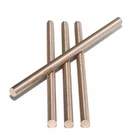
Gr5 Titanium Bar, also known as Ti6Al4V Titanium Bar, is a widely used titanium alloy due to its excellent combination of high strength, low density, and good corrosion resistance. The Poisson's ratio of Gr5 Titanium Bar typically falls in the range of 0.31 to 0.34. This value is relatively consistent with other metallic materials, which generally have Poisson's ratios between 0.25 and 0.35.
The specific value of Poisson's ratio for Gr5 Titanium Bar can be influenced by several factors, including the manufacturing process, heat treatment, and the presence of impurities or defects in the material. For example, cold working processes, such as Cold Rolled Titanium Sheet production, can introduce internal stresses and microstructural changes that may slightly affect the Poisson's ratio.
Significance of Poisson's Ratio for Gr5 Titanium Bar
The Poisson's ratio of Gr5 Titanium Bar plays a crucial role in various engineering applications. Here are some key areas where this property is significant:
Structural Design
In structural design, the Poisson's ratio affects the deformation behavior of components made from Gr5 Titanium Bar. When designing a structure, engineers need to consider how the material will deform under load to ensure its safety and performance. For example, in aerospace applications, where weight reduction is critical, Gr5 Titanium Bar is often used. The Poisson's ratio helps engineers accurately predict the lateral contraction or expansion of titanium components during flight, which is essential for maintaining the structural integrity of the aircraft.
Machining and Forming
During machining and forming processes, the Poisson's ratio influences the way the material responds to cutting forces and deformation. A higher Poisson's ratio means that the material will experience more lateral expansion or contraction, which can affect the dimensional accuracy of the machined parts. Understanding the Poisson's ratio of Gr5 Titanium Bar allows machinists to optimize cutting parameters and tool geometries to achieve the desired surface finish and dimensional tolerance.
Material Testing and Quality Control
Poisson's ratio is also an important parameter in material testing and quality control. By measuring the Poisson's ratio of Gr5 Titanium Bar samples, manufacturers can assess the material's uniformity and consistency. Deviations from the expected Poisson's ratio value may indicate the presence of defects or variations in the material's microstructure, which can affect its mechanical properties and performance.
Applications of Gr5 Titanium Bar
The unique combination of properties, including its Poisson's ratio, makes Gr5 Titanium Bar suitable for a wide range of applications. Some of the most common applications include:
Aerospace Industry
In the aerospace industry, Gr5 Titanium Bar is used in the manufacture of aircraft components such as landing gear, engine parts, and structural frames. The high strength-to-weight ratio and good corrosion resistance of Gr5 Titanium Bar make it an ideal material for these applications. The Poisson's ratio is considered during the design and analysis of these components to ensure their proper functioning under extreme conditions.
Medical Industry
Gr5 Titanium Bar is also widely used in the medical industry for the production of orthopedic implants, dental implants, and surgical instruments. The biocompatibility of titanium makes it suitable for use in the human body, and its mechanical properties, including the Poisson's ratio, are carefully considered to ensure the long-term performance and stability of the implants.
Marine Industry
In the marine industry, Gr5 Titanium Bar is used in the construction of ship hulls, propellers, and other components exposed to seawater. The excellent corrosion resistance of titanium makes it a preferred material for these applications, and the Poisson's ratio is taken into account during the design process to ensure the structural integrity of the marine structures.


Conclusion
In conclusion, the Poisson's ratio of Gr5 Titanium Bar is an important mechanical property that affects its deformation behavior, performance, and suitability for various applications. As a supplier of Ti6Al4V Titanium Bar, I understand the significance of this property and ensure that our products meet the highest quality standards.
If you are interested in purchasing Gr5 Titanium Bar or have any questions about its properties and applications, please feel free to contact us for a detailed discussion. We are committed to providing you with the best products and services to meet your specific needs.
References
- Callister, W. D., & Rethwisch, D. G. (2016). Materials Science and Engineering: An Introduction. Wiley.
- ASM Handbook, Volume 2: Properties and Selection: Nonferrous Alloys and Special-Purpose Materials. ASM International.