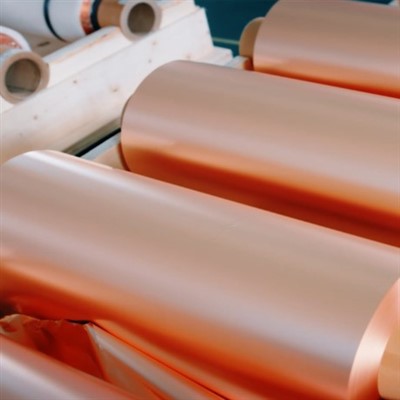
As PCBs move toward higher layer counts, thicker boards, and lead-free assembly, they are subjected to extreme thermal stress during pressing and multiple reflow cycles. Standard (STD) copper foil can become brittle at high temperatures, leading to inner-layer cracking, micro-vias failure, and board warpage-catastrophic defects that ruin yield.
HTE (High Temperature Elongation) Copper Foil is engineered specifically to solve this. By utilizing a specialized refined crystal structure, HTE foil maintains exceptional ductility and elongation even at 180°C. When the epoxy resin expands rapidly during high-temperature lamination, our HTE foil stretches with it, absorbing the stress and preventing copper traces from breaking. Combined with a high peel strength that remains stable at 288°C, HSMetal's HTE foil provides the ultimate reliability guarantee for automotive, industrial, and high-layer-count PCBs.
HSMetal supplies copper foil solutions for industrial buyers and supports specification discussions, product selection, customization assessment, and delivery coordination. Whether you are sourcing HTE Copper Foil for conventional multilayer boards, high-Tg laminates, or HDI applications, we can review your technical requirements and help identify a suitable product specification.
Technical Specification of HTE Copper Foil
| Product Thickness | Unit | 12μm | 18μm | 35μm | 70μm |
| Mass per Unit Area | g/㎡ | 107±3 | 153±4 | 285±8 | 610±10 |
| Tensile Strength (Normal Temp) | MPa | ≥300 | |||
| Tensile Strength (180°C) | MPa | ≥190 | |||
| Elongation (Normal Temp) | % | ≥5 | ≥8 | ≥10 | ≥15 |
| Elongation (180°C) | % | ≥5 | ≥8 | ≥10 | ≥15 |
| Roughness Rz (S Side) | μm | ≤2.5 | ≤2.5 | ≤2.5 | ≤2.5 |
| Roughness Rz (M Side) | μm | ≤6.5 | ≤8 | ≤10 | ≤12 |
| Peel Strength (Normal Temp) | lb/in | ≥7 | ≥8 | ≥11 | ≥15 |
| Peel Strength (288°C Solder Float) | lb/in | ≥6 | ≥7 | ≥9 | ≥12 |
| High-Temp Anti-Oxidation | - | 200℃ 60min, Non-oxidation | |||
👉 Explore HTE Copper Foil Specs & Request a Sample
What Is HTE High Temperature Elongation Copper Foil?
HTE (High Temperature Elongation) Copper Foil is a type of electrolytic copper foil designed to provide good elongation performance at elevated temperatures while maintaining the mechanical properties and bonding characteristics required for PCB manufacturing. Its high-temperature ductility helps reduce the risk of copper cracking caused by thermal stress during multilayer PCB lamination and related heating processes. Depending on the grade and surface treatment, HTE copper foil can be used with FR-4, high-Tg, halogen-free, and other compatible laminate systems.
It is commonly considered for multilayer printed circuit boards, HDI boards, and selected high-temperature PCB applications where thermal reliability, adhesion, and etching performance must be evaluated together.

HTE Copper Foil vs. RTF Copper Foil: What Is the Difference?
HTE and RTF copper foil are both used in PCB manufacturing, but they are designed around different material and surface-performance priorities.
- HTE Copper Foil focuses on high-temperature elongation and mechanical performance under thermal stress. It is commonly considered for multilayer boards, high-Tg laminates, and PCB processes where elevated-temperature ductility is important.
- RTF Copper Foil, or Reverse Treated Foil, uses a reverse-treated surface structure. Its surface treatment is designed to provide a balance of resin adhesion and circuit-processing characteristics, depending on the product grade. RTF is often evaluated for multilayer and selected high-frequency PCB applications.
| Comparison Item | HTE Copper Foil | RTF Copper Foil |
|---|---|---|
| Main Design Focus | High-temperature elongation and mechanical ductility | Reverse-treated surface and adhesion/process balance |
| Key Selection Factor | Elongation at elevated temperature | Surface profile, adhesion, and resin compatibility |
| Typical PCB Applications | Multilayer PCB, high-Tg laminates, selected HDI applications | Multilayer PCB, selected high-frequency and fine-circuit applications |
| Thermal Processing | Consider when thermal stress and high-temperature ductility are important | Evaluate according to the RTF grade and laminate process |
| Surface Characteristics | Depends on HTE grade and treatment | Reverse-treated surface structure |
| Buyer Priority | Thermal elongation, tensile strength, peel strength, and substrate compatibility | Surface roughness, peel strength, etching, and dielectric compatibility |
If your design demands the absolute lowest signal loss for AI servers, you may need to step up to our HVLP Copper Foil. If you are making flexible boards, check out our RA Copper Foil for FPC.
Core Advantages of Our HTE High Temperature Elongation Copper Foil

- Excellent high-temperature ductility: Consistent elongation retention at 180°C, suitable for PCB with multiple thermal cycles and reflow soldering.
- Controlled dual-side roughness: Ultra-low S-side roughness for fine-line HDI patterning; tunable M-side roughness for stable adhesion to resin substrate.
- Outstanding thermal oxidation resistance: Passes 200°C / 60 min anti-oxidation test, avoids discoloration and surface degradation during lamination and high-temperature processing.
- Low residual stress: Minimizes board warpage after lamination, a common pain point for thin HDI substrates.
- Stable peel strength after thermal shock: Reliable bond strength after 288°C solder float test, reduces delamination risk for multilayer stacks.
👉 Send your specification for a quotation
Applications of HTE (High Temperature Elongation) Copper Foil
HTE copper foil is engineered for PCB applications where thermal reliability, ductility, and adhesion are critical. Here is how it maps to specific board designs:
| Application Field | Key Focus / Challenge | Buyer Selection Considerations |
|---|---|---|
| 1. Multilayer PCBs | Preventing inner-layer cracking and warpage during pressing. | Confirm layer count, lamination temperature profile, prepreg compatibility, copper thickness, and peel strength. |
| 2. High-Tg Laminates | Withstanding extreme thermal stress better than standard Tg materials. | Check 180°C elongation rate, tensile strength, and specific resin system adhesion. |
| 3. HDI Boards | Balancing thermal reliability with fine-line etching. | Beyond high-temp elongation, verify copper thickness, surface roughness, and dimensional stability. (Tip: For ultra-fine lines, consider RTF or HVLP foils). |
| 4. Halogen-Free PCBs | Ensuring compatibility with specialized, eco-friendly resins. | Verify mechanical performance and adhesion with your specific halogen-free resin formulation. |
| 5. High-Reliability Assemblies | Surviving multiple reflow soldering cycles and harsh operating conditions. | Must pass complete PCB-level qualification tests; do not rely solely on foil material specs. |
For complete selection logic, insertion loss comparison, substitution reference table and step-by-step procurement checklist for high-speed PCB copper foil, please read our HTE Copper Foil: Industry Guide & Buyer Selection Handbook.
About Us
HSMetal focuses on the supply of copper foil and related copper materials for the electronics, PCB, and lithium-ion battery industries. Our product portfolio covers HTE (High Temperature Elongation) Copper Foil, standard electrolytic copper foil, RTF, VLP and HVLP copper foil, rolled copper foil, surface-treated copper foil, and functional copper foil products for battery applications.
At HSMetal, we understand that in high-reliability electronics, failure is not an option. As a specialized manufacturer of advanced copper foils, we engineer our HTE (High Temperature Elongation) Copper Foil to withstand the most severe thermal stress of high-Tg lamination and lead-free reflow soldering. For HTE copper foil, we support customers in reviewing key technical requirements such as thickness, tensile strength, high-temperature elongation, surface roughness, and peel strength to help match the material with multilayer PCB, high-Tg laminate, and HDI manufacturing requirements. Across our broader copper foil product range, we coordinate product specifications, customized dimensions, surface-treatment requirements, quality documentation, packaging, and delivery arrangements according to individual project needs and confirmed supply capabilities.
By working with customers to understand their applications and purchasing specifications, HSMetal aims to provide practical copper foil sourcing solutions, responsive technical communication, and reliable order coordination for both standard and customized requirements.

Electrolytic Copper Foil

Electrolytic Copper Foil

Rolled Copper Foil

Electrochemical Data Analysis

Precision Inspection of Copper Foil

Lab Testing For Copper Foil Performance
Request a Quote for HTE High Temperature Elongation Copper Foil
Need a reliable supply option for HTE High Temperature Elongation Copper Foil for multilayer PCBs, high-Tg laminates, or HDI applications?
Send us your required thickness, width, quantity, substrate type, elongation requirements, peel strength, surface specifications, and delivery destination.
FAQ
Q1: What is HTE High Temperature Elongation Copper Foil?
A: HTE High Temperature Elongation Copper Foil is an electrolytic copper foil designed to maintain suitable elongation and mechanical properties at elevated temperatures. It is commonly used in multilayer PCB and other applications where thermal processing and copper ductility are important.
Q2: What is the main advantage of HTE copper foil?
A: Its main advantage is high-temperature elongation. This property helps the copper foil accommodate thermal and mechanical stress during PCB manufacturing. Buyers should evaluate the actual elongation value at the specified test temperature.
Q3: What applications use HTE copper foil?
A: Common applications include multilayer printed circuit boards, high-Tg laminates, selected HDI boards, FR-4 and compatible halogen-free PCB materials. The final application depends on the product grade and substrate compatibility.
Q4: What is the difference between HTE and RTF copper foil?
A: HTE copper foil focuses on high-temperature elongation and mechanical ductility. RTF copper foil uses a reverse-treated surface structure designed to balance adhesion and circuit-processing requirements. The correct choice depends on the laminate system, thermal process, surface profile, and PCB design.
Q5: Is HTE copper foil suitable for high-Tg PCB materials?
A: HTE copper foil can be considered for high-Tg PCB materials when its elevated-temperature mechanical properties, peel strength, and surface characteristics meet the laminate manufacturer's requirements. Compatibility should be verified with the actual resin and prepreg system.
Q6: Can HTE copper foil be used for HDI boards?
A: Yes, but it depends on the design. HTE is excellent for the thermal reliability of HDI boards. However, if your HDI board has extremely fine lines and operates at high frequencies, you must also evaluate the foil's surface roughness. In such cases, a low-profile or ultra-low-profile foil may be required. You can explore our RTF and HVLP Copper Foil options for fine-line applications.
Q7: Is HTE copper foil suitable for flexible PCB applications?
A: It may be considered for selected flexible or rigid-flex applications, but repeated dynamic bending requires additional evaluation. RA copper foil or dedicated flexible-circuit copper foil may be more suitable when bending fatigue resistance is the primary requirement.
Q8: How do I choose the right HTE copper foil thickness?
A: Consider the PCB layer structure, current requirements, line width and spacing, etching process, and substrate construction. Confirm the nominal thickness and tolerance with the PCB design and manufacturing team before ordering.
Q9: Why should I compare elongation at elevated temperatures?
A: Room-temperature elongation does not fully represent how copper foil behaves during high-temperature processing. Comparing elongation at the relevant test temperature provides more useful information for evaluating thermal ductility and process suitability.
Q10: What is HTE Copper Foil primarily used for?
A: HTE (High Temperature Elongation) Copper Foil is primarily used as a conductive layer in high-reliability printed circuit boards (PCBs) and copper-clad laminates (CCLs). Its main purpose is to maintain excellent ductility and elongation at elevated temperatures (e.g., 180°C), preventing inner-layer copper cracking, delamination, and board warpage during high-temperature lamination and lead-free reflow soldering.
Q11: Why is high-temperature elongation so critical for multilayer PCBs?
A: During the PCB lamination process, temperatures exceed 180°C, causing the epoxy resin to expand rapidly. If the copper foil is brittle and cannot stretch (low elongation), it will crack under the stress. HTE foil maintains an elongation of ≥5% to ≥15% at 180°C, allowing it to stretch with the resin, thereby ensuring the mechanical integrity and electrical continuity of thick, high-layer-count boards.
Q12: What is the main difference between HTE and RTF copper foil?
A: They solve different problems. HTE is optimized for thermal reliability (surviving extreme heat without cracking). RTF (Reverse Treated Foil) is optimized for signal integrity (reducing high-frequency insertion loss). If your board faces extreme thermal stress, choose HTE. If your board operates at high frequencies and signal loss is the bottleneck, choose High-Speed RTF Copper Foil or HVLP Copper Foil.
Q13: Can HTE foil be used for Flexible Printed Circuits (FPC)?
A: Not typically. While HTE has high elongation at high temperatures (thermal stretching), FPCs require resistance to repeated dynamic bending at room temperature. For flexible circuits and foldable devices, RA (Rolled Annealed) Copper Foil is the industry standard due to its horizontal grain structure and superior flex fatigue resistance. Explore our RA Copper Foil for FPC.
Q14: What thickness of HTE copper foil should I select for my HDI PCB?
A: 12μm and 18μm are the most popular grades for fine-line HDI. 35μm and 70μm are recommended for power circuits and multilayer boards with higher current load and mechanical strength demand.
Q15: What makes HSMetal's HTE foil different from competitors?
A: Many competitors sacrifice high-temperature elongation for tensile strength. HS Metal achieves a perfect balance: we maintain ≥300 MPa tensile strength while ensuring the 180°C elongation remains ≥5% to ≥15% (identical to normal temperature elongation). This ensures both mechanical strength and thermal reliability.
Hot Tags: HTE Copper Foil, High Temperature Elongation copper foil, HTE vs RTF copper foil, copper foil for high Tg PCB, multilayer PCB copper foil, automotive PCB materials, HTE copper foil supplier