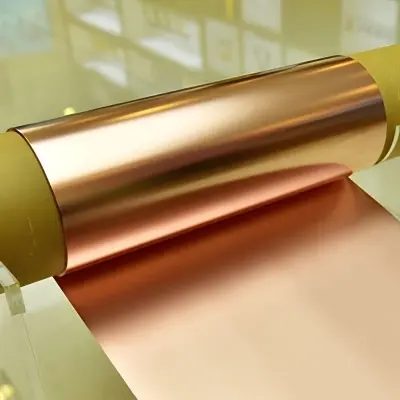
Looking for reliable Reverse Treated Copper Foil (RTF) for high-performance printed circuit boards?
Our RTF Copper Foil is engineered for PCB manufacturers and electronic material suppliers who require a balanced combination of surface profile, copper-to-resin adhesion, peel strength, etching performance and production consistency.Designed for multilayer PCBs, high-density interconnect (HDI) boards, high-speed communication equipment, automotive electronics and other advanced electronic applications, RTF copper foil provides a practical solution for applications where electrical performance and reliable lamination are equally important.
Unlike conventional electrolytic copper foil, Reverse Treated Copper Foil uses a specially designed reverse-treatment process to optimize the bonding interface while maintaining a suitable copper surface profile. This helps PCB manufacturers achieve reliable resin adhesion, stable lamination and precise circuit fabrication.
From standard RTF copper foil to customized thicknesses, widths and performance requirements, we provide flexible manufacturing solutions, technical support and responsive delivery services for global customers.
Technical Specifications
| Product Thickness (mm) |
7 μm | 9 μm | 12 μm | 18 μm | 35 μm | 70 μm | |||
| Unit Area Weight (g/m²) |
62±2 | 80±2 | 107±3 | 153±4 | 285±8 | 610±10 | |||
| Tensile Strength (MPa) | Normal | ≥300 MPa | |||||||
| 180°C | ≥190 MPa | ||||||||
| Elongation (%) |
Normal | ≥8 | ≥10 | ≥11 | ≥13 | ≥18 | ≥18 | ||
| 180°C | ≥8 | ≥10 | ≥11 | ≥13 | ≥18 | ≥18 | |||
| Roughness Rz (μm) |
RTF‑3 | S side | >1.5μm and ≤2.0μm | ||||||
| M side | >1.5μm and ≤2.0μm | ||||||||
| RTF‑4 | S side | >1.0μm and ≤1.5μm | |||||||
| M side | >1.0μm and ≤1.5μm | ||||||||
| Peel Strength (N/mm) | Normal | ≥3.5 | ≥3.5 | ≥3.5 | ≥3.5 | ≥4 | ≥4 | ||
| 288℃, 10s dip solder, 3 times | ≥3 | ≥3 | ≥3 | ≥3 | ≥3.5 | ≥3.5 | |||
| Anti-oxidation (200°C/60min) | Non-oxidation after 200℃,60min | ||||||||
👉 Explore RTF Specifications & Request a Sample
What Is Reverse Treated Copper Foil?
Reverse Treated Copper Foil (RTF) is a type of electrolytic copper foil featuring a specially engineered reverse surface-treatment process, in which the original shiny side of the copper foil receives additional treatment to create a controlled bonding surface. This unique structure provides a balance of reliable copper-to-resin adhesion, controlled surface roughness, good peel strength and stable etching performance.
RTF copper foil is widely used in multilayer PCBs, HDI circuit boards, high-speed communication equipment, automotive electronics and other advanced electronic applications where both bonding reliability and electrical performance are essential.

RTF vs ED vs VLP/HVLP vs RA Copper Foil: Which One Should You Choose?
Choosing the right copper foil is essential for PCB performance, manufacturing efficiency and total material cost.
Different copper foil types are designed for different surface profiles, mechanical properties and processing requirements.
| Copper Foil Type | Main Characteristics | Recommended Applications |
|---|---|---|
| Standard ED Copper Foil | Conventional electrodeposited copper foil with a treated bonding surface | General-purpose PCB and standard multilayer boards |
| RTF Copper Foil | Reverse surface treatment, controlled profile and reliable bonding | Multilayer PCB, HDI, high-speed communication and automotive electronics |
| VLP Copper Foil | Very low surface profile | High-speed and higher-frequency PCB applications requiring lower conductor roughness |
| HVLP Copper Foil | Ultra-low-profile surface designed for demanding high-frequency signal transmission | Advanced server, switch, high-speed networking and demanding RF applications |
| RA Copper Foil | Rolled and annealed structure, typically with excellent flexibility and bending performance | Flexible circuits, dynamic flex applications and selected specialty PCBs |
Commercial & Delivery Terms
| Term | Details |
|---|---|
| MOQ | 200kg |
| Lead Time | Standard stocked Lead time 3–7 working days, Customized specifications Lead Time: 15-20 working days |
| Shipment | Sea freight, air freight, express delivery |
| Packaging | Export-standard moisture-barrier wooden cases |
| Trade Term | FOB (Shanghai, Qingdao or any other china ports) / EXW / CIF |
| Payment Terms | 30% TT deposit, balance before shipment; L/C at sight. |
👉 Send your specification for a quotation
Applications of Reverse Treated Copper Foil (RTF)
Our RTF copper foil is designed for high-speed circuit applications requiring an optimal balance of low signal loss, high peel strength, and processability.
| Application Field | Key Requirements | Why Choose RTF? |
|---|---|---|
| Multilayer PCBs (MLPCB) | Reliable adhesion & stable lamination. | The micro-roughened M-side ensures strong bonding without compromising signal layers. |
| HDI Boards | Fine-line etching & high-density structures. | Uniform grain structure provides excellent etchability and dimensional stability. |
| 5G & High-Speed Comm. | Low insertion loss & signal integrity. | The ultra-smooth S-side minimizes the skin effect for stable data transmission. |
| AI Servers & Networking | High-layer backplanes & switch boards. | Balances high thermal reliability with the low-loss demands of modern servers. |
| Automotive Electronics | High reliability & thermal stability. | Withstands extreme temperatures (288°C peel strength ≥3.0 N/mm) for under-hood electronics. |
| Industrial Electronics | Stable construction & power management. | Cost-effective solution for control boards requiring robust copper-to-resin adhesion. |
About Us
We are a professional copper foil supplier dedicated to providing high-quality copper foil solutions for the global electronics and PCB manufacturing industries. With a focus on product quality, technical innovation and customer satisfaction, we supply a wide range of copper foil products, including Reverse Treated Copper Foil (RTF), Electrolytic Copper Foil (ED), HVLP Copper Foil, VLP Copper Foil and Rolled Annealed Copper Foil (RA).
Our RTF copper foil is developed to meet the diverse requirements of multilayer PCBs, HDI circuit boards, high-speed communication equipment and automotive electronics. We offer flexible customization options for thickness, width, surface characteristics and other technical specifications to meet different manufacturing requirements.
Committed to reliable quality, competitive pricing and responsive customer service, we provide professional technical support, customized product solutions and efficient delivery arrangements for PCB manufacturers, electronic material distributors and industrial buyers worldwide.
Whether you need standard copper foil specifications, customized RTF copper foil or long-term bulk supply, we are ready to support your business with dependable products and professional service.

Automated Production Line for Copper Foil

Finished Jumbo Roll of Copper Foil

Copper Foil Clean‑room Production Workshop

Comprehensive Real‑Time Monitoring of Electrolyte Additives

Quality Control Inspection For Electrodeposited Copper Foil On Production Line

High‑Precision Analysis of Copper Foil Microstructure
Looking for a Reliable RTF Copper Foil Manufacturer?
Stop overpaying for ultra-low-loss materials on layers that don't need them, and stop risking delamination with materials that are too smooth. HS Metal's Reverse Treated Copper Foil gives you the exact balance your high-speed PCB demands.
Send us your requirements today:
- Required thickness (7 μm – 70 μm)
- Grade preference (RTF-3 or RTF-4)
- Width and roll dimensions
- Application (5G, AI Server, HDI, FPC)
Our technical team will recommend the optimal configuration and provide a fast quotation.
FAQ
Q1: What is Reverse Treated Copper Foil (RTF)?
A: Reverse Treated Copper Foil is a type of electrolytic copper foil featuring a specially designed reverse surface-treatment structure. It is developed to balance copper-to-resin adhesion, surface profile and PCB manufacturing performance.
Q2: What is the main advantage of RTF copper foil?
A: Its main advantage is the balance between reliable bonding performance and controlled surface roughness. It is suitable for multilayer PCBs and selected high-speed electronic applications where both adhesion and electrical performance matter.
Q3: What is the difference between RTF and standard ED copper foil?
A: Standard ED copper foil typically uses a conventional treatment configuration, while RTF uses a reverse-treated surface structure. RTF is designed to improve the balance between bonding performance and surface profile for selected advanced PCB applications.
Q4: Is RTF copper foil suitable for high-frequency applications?
A: Yes, selected RTF grades can be used in high-frequency and high-speed PCB applications. However, suitability depends on actual surface roughness, operating frequency, dielectric properties, circuit design and signal-loss requirements. For more demanding applications, VLP or HVLP should also be evaluated.
Q5: What is the difference between RTF and HVLP copper foil?
A: RTF describes a reverse surface-treatment configuration, while HVLP refers to an ultra-low-profile copper foil category. HVLP is generally intended for more demanding signal-loss requirements. RTF can be a practical choice when its actual electrical performance and bonding characteristics meet the PCB design specifications.
Q6: Which copper foil is better for HDI PCB manufacturing?
A: RTF and VLP can both be considered for HDI applications. The correct choice depends on line width, copper thickness, substrate compatibility, surface roughness, peel strength and signal-integrity requirements.
Q7: Can RTF replace HVLP copper foil?
A: It depends on your layer. RTF is highly recommended for inner layers and high-speed backplanes because it offers low loss with much better peel strength and lower cost. For outer layers or 112G/224G ultra-high-speed channels where loss must be minimized, HVLP is still necessary.
Q8: How do I choose between 12 μm, 18 μm and 35 μm RTF copper foil?
A: 12 μm copper foil is commonly evaluated for thin copper constructions and fine-line circuit designs. 18 μm is a common choice for multilayer PCB applications requiring a balance between conductor thickness and circuit density. 35 μm is suitable for designs requiring a thicker copper conductor or higher current-carrying capacity. Final selection must also consider etching compensation, impedance design and thermal performance.
Q9: Can RTF copper foil be used with FR-4 substrates?
A: Yes, RTF copper foil can be used with compatible FR-4 laminates and prepregs. The specific RTF grade should be selected according to the resin system, lamination conditions and required peel strength.
Q10: Can you customize the width and thickness of RTF copper foil?
A: We can discuss customized thicknesses, widths, roll dimensions and surface requirements according to production capabilities and order quantities. Please send us your technical specifications for confirmation.
Q11: Does RTF have better peel strength than HVLP?
A: Yes. Because RTF uses a micro-roughened matte side to grab the resin, its peel strength is generally higher and more stable than HVLP. Even after 288°C thermal stress, our RTF maintains ≥3.0 N/mm peel strength, reducing the risk of delamination during PCB drilling and assembly.
Q12: Is this product ready for mass production?
A: Yes. HS Metal has an annual capacity of 20,000 tons for RTF copper foil. We support both R&D sampling and high-volume mass production orders with guaranteed batch-to-batch consistency.
Q13: Which RTF grade should I choose for FPC production?
A: RTF‑4 is recommended for fine-line FPC with narrow traces and high density. RTF‑3 works well for general FPC, shielding layers and cost-sensitive flexible projects.
Q14: Can RTF copper foil be used for high-frequency rigid PCB?
A: Yes, RTF is suitable for mid-frequency high-speed rigid boards and HDI. It is not recommended for 5G mmWave, ultra-low-loss PTFE high-frequency circuits where HVLP copper foil is a better match.
Q15: Does RTF copper foil have good shielding performance?
A: Yes. Its double-sided uniform low-profile structure delivers stable electromagnetic shielding performance, widely used in consumer electronics, automotive sensor flexible circuits to suppress signal crosstalk.
Hot Tags: Reverse Treated Copper Foil, RTF copper foil, RTF Copper Foil for PCB, RTF Copper Foil for HDI, high-speed PCB copper foil, low profile copper foil, copper foil for 5G servers, RTF vs HVLP