


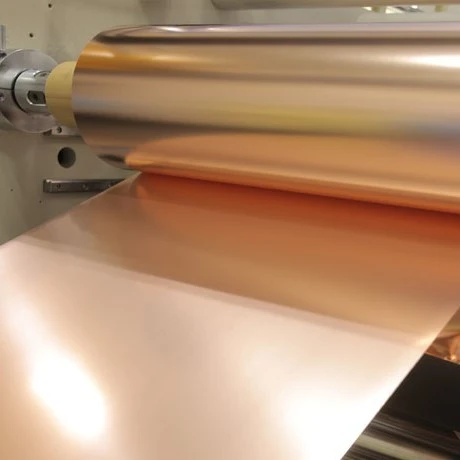

We supply premium Rolled Copper Foil, also known as rolled annealed copper foil. Our high tensile annealed rolled copper foil is manufactured with our in-house precision rolling and controlled annealing process, tailored for high-spec FPC and flexible electronic projects.
Our technical team optimizes annealing parameters within the 650°C–800°C temperature window to regulate grain structure and eliminate internal lattice defects. This delivers consistent high ductility, outstanding bending fatigue resistance and stable electrical conductivity - solving common customer challenges such as foil cracking during repeated folding, uneven material performance and unstable surface quality for demanding flexible circuit applications.
Supported by mature production workflows and strict batch inspection systems, our factory maintains stable capacity even under high-demand order schedules. We keep tight control over thickness uniformity, surface finish and mechanical properties throughout mass production, ensuring reliable quality and on-time delivery to meet tight customer timelines. Our rolled annealed copper foil serves as the preferred conductive material for flexible printed circuit (FPC), flexible flat cables, EMI shielding films and wearable electronic components.
Quick Answers For Rolled Copper Foil
What is rolled copper foil?
Rolled annealed (RA) copper foil is manufactured by rolling a copper ingot through multiple passes, then annealing to achieve the desired temper. Unlike electrodeposited (ED) foil, RA foil has an elongated grain structure parallel to the foil surface, giving it superior flex fatigue resistance - essential for flexible printed circuits (FPC) that bend repeatedly in service.
Why choose RA foil over ED foil for FPC?
| Your Priority | RA Foil Advantage | ED Foil Limitation |
|---|---|---|
| Dynamic flexing / bending | Elongated grains resist crack propagation | Random grain structure cracks under repeated flexing |
| Smooth surface | Naturally smooth both sides (Rz < 2μm) | Requires roughening treatment for adhesion |
| High-frequency signal integrity | Lower surface roughness = lower insertion loss | Rougher surface increases conductor loss at GHz frequencies |
| Ductility | Elongation 15–25% | Elongation 5–12% |
Recommended Specifications for FPC
| Thickness | Temper | Tensile Strength | Flex Life | Application |
|---|---|---|---|---|
| 12μm | H04 (Hard) | ≥295 MPa | >100,000 cycles | Static flex, rigid-flex |
| 18μm | H04 | ≥295 MPa | >150,000 cycles | Dynamic flex connectors |
| 25μm | H04 | ≥295 MPa | >200,000 cycles | Hinge flex, camera modules |
| 35μm | H04 | ≥295 MPa | >100,000 cycles | High-current flex |
Not sure if rolled copper foil is the right fit for your FPC, RF or foldable device project? Explore our complete comparison article: [Article: Electrolytic vs Rolled Copper Foil: Quick Selection & Procurement Pitfall Guide].
Compare grain structure, bending life, roughness requirements and real‑world procurement cases between ED and RA copper foil to validate your material specification before sampling and mass order.
What Is Rolled Annealed Copper Foil?
Rolled annealed (RA) copper foil starts as a thick copper ingot, which undergoes hot rolling, multiple cold rolling passes, and intermediate annealing to reach the target thickness. The final annealing step recrystallizes the grain structure into large, flat grains oriented parallel to the foil surface.
This manufacturing process creates a material fundamentally different from electrodeposited (ED) copper foil. While ED foil is grown atom-by-atom onto a rotating drum, producing an equiaxed (random) grain structure, RA foil's elongated horizontal grains allow it to flex repeatedly without cracking.
Standards & Equivalents:
ASTM B152 (Copper Sheet, Strip, Plate)
GB/T 5187-2021
JIS H3100
UNS C11000, C10200
Rolled Copper Foil VS Electrolytic Copper Foil
Many FPC buyers get confused between rolled copper foil and electrolytic copper foil.
- Production process: Rolled copper foil is manufactured by repeated cold rolling and annealing. Electrolytic copper foil is deposited by electroplating in electrolyte.
- Bending performance: Rolled copper foil has far better bending fatigue resistance, suitable for dynamic repeated bending scenarios. Electrolytic copper foil is more suitable for static battery current collector applications, poor at frequent folding.
- Crystal structure: Rolled copper has elongated grain structure; electrolytic copper has columnar crystal grains.
- Surface: Rolled copper features smooth and consistent two-side surface. Electrolytic copper has a shiny drum side and rough matte side.
- Cost: Rolled copper foil is higher in cost compared with electrolytic copper foil.
Key Properties (H04 Hard Temper)
| Property | Value | Advantage |
|---|---|---|
| Tensile Strength | ≥295 MPa | High strength for thin-gauge handling |
| Elongation | 15–25% (RA) vs 5–12% (ED) | Superior ductility for bending |
| Surface Roughness | Rz < 2μm | Lower signal loss at high frequencies |
| Purity | ≥99.9% Cu | High electrical conductivity |
| Grain Structure | Elongated, parallel to surface | Excellent flex fatigue resistance |
| Thickness Range | 12–70μm | Optimize flex life vs. current capacity |
Product Features & Basic Technical Parameters
- Available Thickness: 9μm, 12μm, 18μm, 25μm, 35μm, 50μm
- Width Range: 10mm ~ 600mm, custom slitting available
- Temper: Annealed / Soft, High tensile hard temper
- Surface: Bright rolled surface, uniform texture, low surface roughness
- Outstanding bending fatigue resistance, withstands repeated folding without cracking
- Stable electrical conductivity and good adhesion with polyimide substrate
- Complete Mill Test Certificate provided for every batch
Application & Material Selection Guidance
| End Application | Recommended Thickness | Temper | Why |
|---|---|---|---|
| Dynamic flex (hinges, camera) | 12–25μm | H04 | High flex life, thin for flexibility |
| High-frequency FPC (5G, radar) | 12–18μm | H04 | Smooth surface minimizes skin effect loss |
| Rigid-flex boards | 18–35μm | H04 | Balance of flexibility and current capacity |
| High-current flex | 35–70μm | H04 | Lower resistance for power delivery |
| EMI shielding flex | 18–35μm | O60 (Soft) | Formability for complex shapes |
When to Choose RA Foil
If your product requires repeated bending, folding, dynamic flexing, such as foldable FPC and wearable devices. It is the best choice for high cycle bending requirements.
- Dynamic flex applications - FPC that bends repeatedly in service (camera modules, hinges, wearable devices)
- High-frequency circuits - 5G mmWave, automotive radar, where surface roughness drives signal loss
- Long flex life requirements - >100,000 bend cycles
- Smooth surface needs - Fine-line etching requires low-profile copper
When ED Foil Is Sufficient
For lithium battery anode current collector, static EMI shielding, cost-sensitive projects without frequent bending.
- Static flex - FPC that bends once during assembly, then stays fixed
- Cost-sensitive projects - ED foil is 20–40% cheaper
- Standard PCB applications - Rigid boards, power electronics
Why Choose HSMetal?
Technical Strength: Solve High-Difficulty Copper Foil Challenges
Our in-house material engineering team masters the full process of rolling and annealing. We precisely control annealing temperature within 650°C–800°C to adjust copper grain structure and eliminate internal lattice defects. We help customers tackle common tough problems: copper foil cracking under thousands of bending cycles, unstable tensile performance batch to batch, inconsistent thickness and poor surface finish. For special high-spec requirements such as ultra-thin gauge, strict bending fatigue index and customized surface condition, our team can optimize rolling reduction and heat treatment parameters according to your FPC manufacturing process.
Production Capability: Stable Quality & Scalable Output Under Peak Demand
Even facing large-volume rush orders and high market demand cycles, our production line can boost output while maintaining strict quality standards. We implement full-process quality inspection, covering raw material incoming inspection, rolling monitoring, annealing tracking, finished slitting and final visual & mechanical testing. Every roll is inspected for thickness, tensile strength, elongation and surface defects. We balance expanded production capacity and zero compromise on material consistency, to deliver goods on schedule and fulfill your tight order deadlines.
Our Custom Service & How We Meet Buyer Requirements
We understand the main pain points of FPC manufacturers: foil cracking during bending, inconsistent thickness, edge burr after slitting. We provide precision custom slitting service with neat burr-free edges. Before order confirmation, we confirm thickness, width, temper and surface requirements. Small trial sample orders are available for FPC prototype testing. We supply full MTC documents for incoming QC inspection and customs clearance. During mass production, we keep customers updated on production schedule and offer technical support for laminating and etching processes.
Customer Case
- The Rolled copper foil with soft temper used as a conductor in the apparel for cancer treatment research from our Indonesia customer.

- Our ED Shielding Copper Foils with High Elongation and High Tensile Strength, can be used in many areas. We can provide the specific single-matte, double-matte, and double-shiny ED Copper for the Li-ion Battery. And we can also offer 2oz to 6oz ( nominal thickness 70um to 210um) Shielded ED Copper Foils used for shielding of electric products, especially as transformer, cable, mobile phone, computer, mechanical treatment, aerospace, and industry Applications . What is more, HTE (high temperature elongation) from 1/2oz to 2oz thickness copper foil and VLP-HTE-HF( very-low-profile, high temperature elongation, and heavy ED Copper Foils, used in PCB, which the max dimension is 1295mm x 2450mm.Below is the US customer Feedback pics for the Shielding Copper Foils used in MRI Room

Commercial Terms
Product: Rolled Copper Foil / High Tensile Annealed Copper Foil
Thickness: 9μm,12μm,18μm,25μm,35μm,50μm
Width: 10mm–600mm, custom slitting
Temper: Annealed soft, high tensile hard temper
Payment Term:T/T: 30% deposit, 70% before shipment
Certificates: Mill Test Certificate
MOQ: Small trial order acceptable
Trade Terms: FOB, CFR, CIF, DAP
Port of Shipment: Shanghai / Ningbo
Delivery Time: Subject to stock and custom slitting schedule
Looking for reliable rolled copper foil supplier for FPC? Send your thickness, width and bending requirement for quotation. We also supply high tensile electrolytic copper foil for lithium battery industry.
About Us
HSMetal is a technology-driven enterprise dedicated to the design, R&D, manufacturing, and sales of advanced copper foil products. Our portfolio features a range of high-end copper foil solutions such as ultra-thin flexible lithium battery copper foil, HVLP high-frequency high-speed ultra-low profile foil, RTF reverse treated foil, ultra-thin carrier foil (peelable copper), blackened foil, buried resistance foil, and microporous copper foil.
With years of specialized experience in R&D and production of ultra-thin flexible copper foil for lithium batteries, we have built a strong track record of delivering high-performance products alongside comprehensive technical support and customized solutions to clients worldwide.
The ultra-thin electronic copper foil series developed by our company exhibits outstanding stability and reliability, making it suitable for a wide array of applications. These include multi-layer printed circuit boards (PCBs), flexible circuit boards, IC packaging substrates, 5G smartphones, servers, base stations, AI-integrated systems, automotive radar, medical devices, and aerospace technologies.
As a critical material in both the lithium battery and electronics industries, copper foil plays an essential role in enabling technological progress. We remain committed to advancing innovation through sustained R&D, continuously improving product quality, and expanding our development of lithium-ion battery materials. Our goal is to consistently provide superior customer service and contribute to the sustainable, high-quality growth of the industry.
Our Factory

Copper Foil Clean‑room Production Workshop

Automated continuous production line for Copper Foil

Finished Jumbo Roll of Copper Foil

Comprehensive Real‑Time Monitoring of Electrolyte Additives

Quality Control Inspection For Electrodeposited Copper Foil On Production Line

High‑Precision Analysis of Copper Foil Microstructue
Our rolled copper foil delivers superior bending fatigue performance, low surface roughness and high conductivity for foldable FPC, 5G/6G RF circuits, AI high‑speed PCB and high‑reliability automotive electronics. It comes with optional customized roughening & activation surface treatment for FCCL lamination.
Before finalizing your bill‑of‑material, read our comprehensive comparison knowledge base article to avoid over‑specification or improper material substitution:
👉 [Article: copper foil selection and procurement pitfall guide]
Inside you will find:
- Clear application boundary between RA copper foil and electrolytic copper foil
- Key procurement pitfalls for surface treatment, thickness tolerance and roughness
- Real‑world cases for sampling validation and incoming‑quality inspection
FAQ
Q1: What is rolled copper foil used for?
A: Rolled copper foil, especially high tensile annealed rolled copper foil, is mainly used for FPC, wearable electronics, flexible flat cables and EMI shielding films, for products requiring repeated bending.
Q2: What is the difference between rolled copper foil and electrolytic copper foil?
A: Rolled copper foil is made by rolling process with excellent bending fatigue resistance, ideal for foldable FPC. Electrolytic copper foil is electroplated, widely used for lithium battery current collectors, not suitable for frequent folding.
Q3: Can you provide custom slitting service for rolled copper foil?
A: Yes. We can slit rolled copper foil into custom target width with clean edge quality. Sample orders and bulk orders are both supported.
Q4: What documents can you provide?
A: Every shipment is accompanied by Mill Test Certificate including thickness, tensile strength, elongation and conductivity test data. Third-party inspection can be arranged on request.
Q5: What is your packaging and lead time?
A: Vacuum moisture-proof packaging for sea shipment to avoid oxidation. Lead time depends on specifications and order quantity.
Q6: Is 6μm copper foil strong enough for high-speed winding?
A: With conventional foil, 6μm is challenging. With HSMetal's 800MPa low-warpage foil, 6μm is suitable for high-speed winding applications - the strength compensates for the reduced thickness.
Q7: Can you supply samples for evaluation?
A: Yes - samples are available for qualified battery manufacturers. Contact our team with your application details.
Q8: Do you provide test certificates?
A: Yes - every shipment includes Mill Test Certificate with tensile strength, elongation, and thickness verification.
Till have questions about copper foil material selection? Visit our full‑depth comparison article: [Article: Electrolytic vs Rolled Copper Foil: Quick Selection & Procurement Pitfall Guide]
Hot Tags: rolled copper foil, RA copper foil for FPC, high tensile annealed copper foil, flexible circuit copper foil, Rolled Copper Foil | High Tensile Annealed Copper Foil for FPC Custom Slit Supplier China Supplier supplier, FPC copper foil supplier


