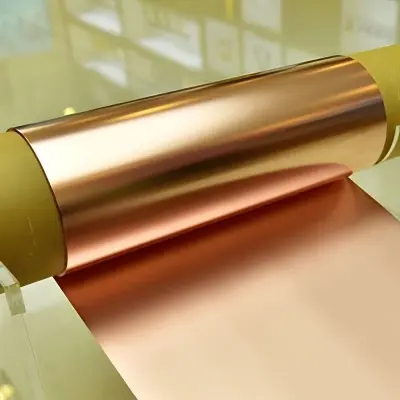
HTE (High‑Temperature Elongation) Copper Foil is a premium grade electrodeposited (ED) copper foil defined under IPC‑4562 specification. It features outstanding elongation performance under high‑temperature conditions, solving the common cracking risk of conventional electrolytic copper foil during high‑temperature lamination, pressing and reflow soldering processes. It is the preferred conductive foil material for multilayer PCB, HDI, high‑TG CCL and automotive electronic circuit substrates.
Different from standard ED copper foil, HTE copper foil retains good ductility after high‑temperature aging treatment. It avoids inner‑layer crack, via‑hole fracture and circuit open‑circuit defects during multi‑layer pressing and thermal cycling. Our HTE copper foil covers thickness from 10 μm up to 105 μm, strictly following the performance parameters including tensile strength, high‑temp elongation, surface roughness, resistivity and peel‑strength as shown in specification table. Every batch comes with complete test reports complying with IPC‑4562, RoHS and REACH.
Compare HTE grade against other ED & RA copper foil types before finalizing BOM: [Article: Electrolytic vs Rolled Copper Foil: Quick Selection & Procurement Pitfall Guide]
Core Selling Points Of HTE Copper Foil From HSMetal
- Superior high‑temperature elongation: Maintains high ductility under 180℃ thermal environment, prevents copper foil cracking during multi‑step lamination and reflow process.
- Stable peel strength on FR‑4 substrate: Reliable bonding force with high‑TG resin, reduces delamination risk for multilayer boards.
- Controlled dual‑side surface roughness: Strict S‑side & M‑side roughness control; balance etching performance and resin adhesion.
- Excellent high‑temperature anti‑oxidation: Passes 220℃ / 30‑minute anti‑discoloration test, stable performance in high‑temp PCB production workflow.
- Wide thickness portfolio: 10 μm ~105 μm options, covers HDI inner layer, multi‑layer outer layer and automotive PCB applications.
- Full‑batch traceability: Each shipment provides COC and full‑item lab test report. Custom slitting service supported.
Key Performance Parameters
| Item | Unit | Specifications |
|---|---|---|
| Nominal Thickness | μm | 10,12,15,18,35,50,70,105 |
| Area Weight | g/m² | 90±3 ~ 870±20 |
| Purity | % | ≥99.8 |
| S‑side Roughness (Ra) | μm | ≤0.43 |
| M‑side Roughness (Rz) | μm | ≤6 ~ ≤20 (depends on thickness) |
| Tensile Strength(R.T.) | MPa | ≥280 |
| Tensile Strength(H.T.180℃) | MPa | ≥150 |
| Elongation(R.T.) | % | ≥3 ~ ≥8 |
| Elongation(H.T.180℃) | % | ≥2 ~ ≥5 |
| Resistivity | Ω·g/m² | ≤0.162‑0.170 |
How to Choose: HTE vs Standard ED vs RA Foil
| Your Application | Recommended Foil | Why |
|---|---|---|
| Multilayer PCB (4+ layers) | HTE ED | Maintains elongation at 180°C through repeated lamination |
| High-Tg / high-reliability CCL | HTE ED | Thermal stability prevents barrel cracks and via failure |
| Standard 2-layer rigid PCB | Standard ED (STD) | Lower cost; no repeated lamination |
| Fine-line HDI | RTF or VLP ED | Smooth side for fine etching |
| High-frequency (>10 GHz) | HVLP or RA | Low profile reduces skin effect |
| Dynamic flex / foldable | RA (rolled-annealed) | Fibrous grain survives millions of folds |
| Lithium battery collector | Standard ED (ultra-thin) | Cost-effective, rough matte side for adhesion |
The key distinction: HTE is about thermal reliability, not high frequency. If your board goes through multiple lamination cycles and must maintain via integrity, specify HTE. If your priority is signal loss at GHz frequencies, specify HVLP or RA.
Buyer Selection Guide: When to choose HTE Copper Foil
👉 Choose HTE High‑Temperature Elongation Copper Foil
Multilayer PCB & HDI boards with multiple high‑temperature pressing cycles
High‑TG CCL substrates, automotive electronics PCB requiring thermal shock resistance
Products sensitive to inner‑layer crack, via fracture after thermal treatment
Industrial control and power electronic boards undergoing repeated reflow soldering
👉 Select general standard electrolytic copper foil instead For simple single‑layer / double‑layer rigid PCB without multi‑times high‑temperature lamination requirement, standard ED copper foil can control your material cost.
View reference product: [Electrolytic Copper Foil]
Important Note: HTE is a special high‑ductility electrolytic copper foil grade, it cannot replace RA rolled‑annealed copper foil for frequent dynamic bending FPC scenarios. For folding flexible circuit projects please refer to rolled copper foil solution.
Why Buyers Choose Our HTE Copper Foil
- Elongation retained at 180°C. Not just room-temperature elongation - H.T. elongation verified at ≥2–5% depending on gauge. This is what prevents cracks during multilayer lamination.
- Consistent low roughness on the shiny side. S-side Ra ≤0.43 μm, suitable for fine-line patterning.
- Strong peel strength to FR-4. Peel values range from ≥0.9 N/mm (10 μm) to ≥2.5 N/mm (105 μm), giving reliable adhesion across thicknesses.
- Oxidation resistance at 220°C. 30 minutes without discoloration - important for high-temperature lamination and subsequent processing.
- Purity ≥99.8%. Controlled chemistry for consistent electrical and mechanical performance.
- Full thickness range. 10–105 μm, covering thin inner layers through heavy outer layers.
- Standards compliance. Manufactured to IPC-4562 and IPC-TM-650 test methods.
Contact our engineering team for datasheet download, sample request and technical consultation.
Typical Applications
- Multilayer PCB: inner and outer layers requiring repeated lamination
- High-Tg CCL: boards exposed to elevated temperature during assembly
- HDI boards: fine-line inner layers
- Automotive electronics: thermal cycling reliability
- Industrial control and power electronics: high-reliability rigid boards
- Telecom and server boards: multilayer constructions
Related standard product:[IPC‑4562 Compliant Copper Foil]
Certificate
Our Certificate


Applications of HTE Copper Foil
- Electronics
Used in printed circuit boards (PCBs), flexible circuits, and RFID antennas.
- Aerospace
Ideal for thermal management systems, sensors, and shielding in high-temperature environments.
- Energy
Employed in solar panels, batteries, and fuel cells for efficient energy transfer.
- Automotive
Used in electric vehicle (EV) components, such as battery connectors and power distribution systems.
- Industrial Heating
Suitable for heating elements and thermal interface materials.
Delivery & Commercial Terms
| Item | Details |
|---|---|
| Quotation | Valid for 30 days. Price subject to LME copper price, raw‑material cost and order volume. Final price confirmed on Proforma Invoice (PI). |
| MOQ | Stock items: negotiable MOQ. Custom specifications: MOQ applies, please consult sales team. Lab evaluation samples are available. |
| Lead Time | Stock goods: 7‑14 working days after receiving deposit.Custom processing: 15‑30 working days, subject to production schedule. |
| Packaging | Standard export anti‑oxidation vacuum packaging with desiccant, carton and wooden pallet. Custom packaging upon request. |
| Storage | Keep in cool, dry, low‑humidity warehouse. Follow FIFO rule to prevent copper foil oxidation. |
| Shipment & Incoterms | EXW, FOB(Shanghai, Qingdao or any of china ports), CFR, CIF. Sea / air shipment for bulk orders; international express for samples. |
| Payment Terms | T/T: 30% deposit after PI confirmation, balance against copy of Bill of Lading. |
| Sample Service | Qualification samples available. Sample cost and freight shall be borne by buyer; sample fee can be deducted from future bulk orders by mutual agreement. |
About Us
We are a specialized manufacturer of IPC‑4562‑B grade electronic copper foil, dedicated to delivering high‑performance electrolytic and rolled‑annealed copper‑foil materials for multilayer PCB, HDI, high‑TG CCL, automotive electronics, high‑frequency communication and new‑energy industries.
Our product portfolio covers standard ED copper foil, premium HTE High‑Temperature Elongation copper foil, HVLP low‑profile foil, double‑sided polished copper foil and RA rolled‑annealed copper foil. Our in‑house material R&D and quality‑control team focus on real manufacturing pain‑points, such as high‑temperature cracking during lamination, insufficient peel strength, thermal‑cycle failure and high‑frequency signal attenuation.
Every production batch undergoes strict lab testing including room‑temperature & high‑temperature tensile‑elongation, surface roughness, resistivity and peel‑strength. All products comply with IPC‑4562‑B, RoHS and REACH standards. Complete COC and batch test reports are provided for each shipment to simplify customers' QA validation.
More than just supplying copper‑foil products, our technical team supports customers throughout the whole project cycle: material feasibility evaluation, sample qualification, grade selection and mass‑production stable supply. We help R&D and procurement teams make rational material decisions, avoid over‑specification and control overall BOM costs.
Deep‑dive into copper‑foil comparison and procurement pitfalls: [Article: Electrolytic vs Rolled Copper Foil: Quick Selection & Procurement Pitfall Guide]
Browse our full‑range copper‑foil offerings: [Electrolytic Copper Foil]|[IPC‑4562 Compliant Copper Foil]
Feel free to contact our engineering team for datasheets, sample requests and technical consultation for your PCB or CCL projects.
Our Factory

Quality Control Inspection For Electrodeposited Copper Foil On Production Line

Finished Jumbo Roll of Copper Foil

Copper Foil Clean‑room Production Workshop

Comprehensive Real‑Time Monitoring of Electrolyte Additives

Automated continuous production line for Copper Foil

Automated continuous production line for Copper Foil
FAQ
Q1: What is HTE copper foil?
A: HTE stands for High Temperature Elongation. It is an electrodeposited (ED) copper foil engineered to maintain ductility after exposure to high temperatures. Unlike standard ED foil, HTE foil keeps its elongation at 180°C, which is the temperature range of multilayer PCB lamination. This prevents cracks, barrel cracks, and via failure during repeated lamination cycles.
Q2: What is the difference between HTE and standard ED copper foil?
A: The main difference is high-temperature elongation. Standard ED foil looks fine at room temperature but becomes brittle after thermal exposure. HTE foil is engineered so elongation remains ≥2–5% at 180°C, depending on thickness. That is why HTE is the default grade for multilayer PCB, while standard ED foil is used for simple 2-layer boards where repeated lamination is not a concern.
Q3: Why does H.T. elongation at 180°C matter for multilayer PCB?
A: Multilayer PCB goes through multiple lamination cycles at high temperature. If the copper foil loses ductility during these cycles, it cracks - especially at via walls and inner-layer connections. H.T. elongation at 180°C is the number that predicts whether your board survives lamination. Room-temperature elongation does not tell you this.
Q4: Which thickness of HTE foil should I use for inner layers?
A: For inner layers, common choices are 10 μm, 12 μm, 15 μm, and 18 μm. Thinner foil (10–12 μm) is used for fine-line inner layers; 18 μm is used where more current-carrying capacity is needed. For outer layers, 35 μm and above are typical. Selection depends on layer count, impedance requirements, and current load.
Q5: What is the difference between S side and M side?
A: S side (shiny side) is the smooth side, with Ra ≤0.43 μm. M side (matte side) is the rough side, with Rz ranging from ≤6 μm (10–12 μm foil) to ≤20 μm (105 μm foil). The matte side bonds to the substrate; the shiny side faces the signal path or etching side.
Q6: Can HTE foil be used for high-frequency applications?
A: HTE is about thermal reliability, not high frequency. HTE foil's shiny side has Ra ≤0.43 μm, which is relatively smooth, but for frequencies above 10 GHz, HVLP or RA foil is usually specified because conductor loss becomes critical. If your priority is multilayer lamination reliability, choose HTE. If your priority is signal loss at GHz frequencies, choose HVLP or RA.
Q7: What is the peel strength of HTE copper foil to FR-4?
A: Peel strength ranges by thickness: ≥0.9 N/mm (10 μm), ≥1.1 N/mm (12 μm), ≥1.2 N/mm (15 μm), ≥1.3 N/mm (18 μm), ≥1.6 N/mm (35 μm), ≥2.1 N/mm (50–70 μm), and ≥2.5 N/mm (105 μm). These values ensure reliable adhesion to standard FR-4 prepreg.
Q8: What is the oxidation resistance of HTE foil?
A: HTE foil is tested for anti-oxidation at 220°C for 30 minutes without discoloration. This matters because multilayer PCB goes through high-temperature lamination and subsequent soldering processes. Foil that oxidizes easily will show discoloration and may affect adhesion or electrical performance.
Q9: Does HTE foil have pinholes or porosity?
A: Our HTE foil is specified as N/A for pinholes and porosity - meaning it meets the requirement of no unacceptable pinholes or porosity for its thickness class. This is verified through standard IPC-TM-650 test methods. Pinhole-free foil is essential for reliable dielectric withstand and long-term board reliability.
Q10: What is the purity of HTE copper foil?
A: Purity is ≥99.8%. Controlled purity ensures consistent electrical conductivity, mechanical properties, and reliable performance through lamination and etching.
Q11: Which standards does HTE copper foil comply with?
A: HTE copper foil is manufactured to IPC-4562 (Metal Foil for Printed Board Applications) and tested per IPC-TM-650 methods. When specifying, state IPC-4562B (the current revision, published October 2023) to avoid version ambiguity with suppliers.
Q12: What is the lead time for HTE copper foil?
A: Standard thicknesses typically ship in 15–25 days after order confirmation. Custom widths or special treatments may require 30–45 days. Ultra-thin gauges (10–12 μm) may need slightly longer due to tighter process control. Confirm lead time at order review.
Q13: Can HTE copper foil replace RA rolled‑annealed copper foil for FPC folding applications?
A: No. HTE improves high‑temperature ductility for static PCB thermal processes, but it still belongs to columnar‑grain electrolytic copper foil. It cannot withstand thousands of repeated dynamic folding cycles. For bend‑demanding FPC projects please select [Rolled Copper Foil].
Q14: Which projects should adopt HTE copper foil?
A: Recommended for multilayer PCB, HDI inner & outer layers, high‑TG CCL substrate, automotive PCB and industrial power boards that go through multiple lamination cycles and thermal shock test. Simple single‑sided / double‑sided rigid PCB can use ordinary [Electrolytic Copper Foil] to control cost.
Q15: What key test items are included in HTE batch test report?
A: Each batch COC report includes: areal weight / thickness, surface roughness (S‑side & M‑side), room‑temp & 180 ℃ high‑temperature tensile strength & elongation, resistivity, peel strength against FR‑4, 220 ℃ anti‑oxidation performance. Documents for RoHS and REACH are available upon request.
Q16: What thickness options are available for your HTE copper foil?
A: Available thickness: 10 μm,12 μm,15 μm,18 μm,35 μm,50 μm,70 μm,105 μm. Custom slitting for different widths is supported. Contact our sales team for non‑standard size feasibility.
Q17: Does HTE copper foil comply with IPC‑4562‑B?
A: Yes. Our HTE copper foil is fully manufactured and inspected according to IPC‑4562‑B requirements.
Q18: What risk will happen if I use ordinary ED foil instead of HTE for high‑TG multilayer PCB?
A: During multiple high‑temperature pressing, inner‑layer copper may crack, leading to open‑circuit failure, high scrap rate and hidden reliability risk for finished boards. It is suggested to validate material grade at sample phase.
Hot Tags: HTE Copper Foil | High Temperature Elongation Foil for Multilayer PCB & High-Reliability CCL China Supplier, High‑Temperature Elongation copper foil, HTE ED copper foil Manufacturer, IPC‑4562 HTE Copper Foil | High Temperature Elongation Foil for Multilayer PCB & High-Reliability CCL, multilayer PCB copper foil, HDI copper foil, high‑TG CCL copper foil, automotive PCB copper foil