


Every AI command you send travels across multi‑gigabit‑per‑second traces inside AI servers and high‑speed switches. The signal performance heavily depends on the quality of copper foil used for inner signal layers of high‑speed PCB. Under the skin‑effect principle, high‑frequency current flows only along the copper surface; uneven rough surfaces create bumpy signal paths, raising insertion loss and degrading overall system throughput.
High‑speed Reverse‑Treated Foil (RTF) copper foil strikes a critical balance between ultra‑low surface roughness, reliable peel strength, high‑temperature dimensional stability and fine‑line etching capability. HSMetal high‑speed RTF copper foil has passed multi‑customer qualification and entered mass‑volume shipment, delivering internationally‑competitive key indicators for CCL and PCB manufacturers building PCIe Gen5 platforms.
If you want to view our formal product specifications, go to High‑Speed RTF Copper Foil product page.
👉 Explore our High-Speed RTF Copper Foil Specifications and Request Quotation
Core Technical Advantages of HSMetal High‑Speed RTF Copper Foil
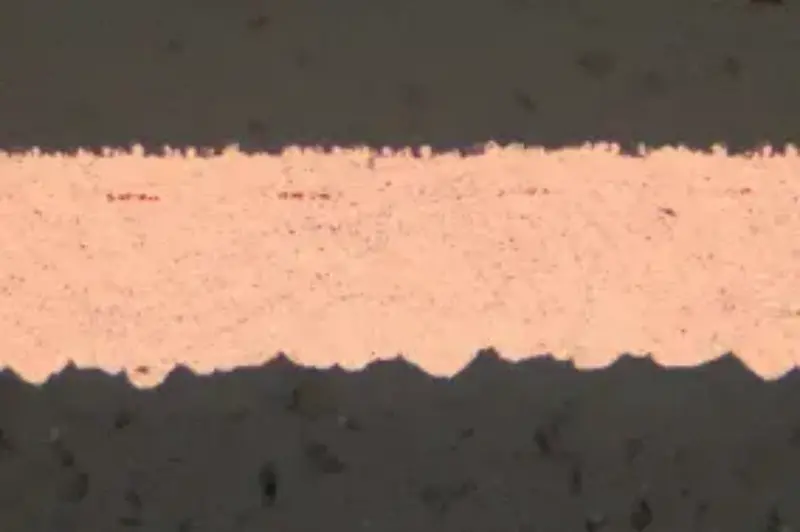
1. Ultra‑smooth treated‑side surface cuts high‑frequency signal loss
We adopt precision cathode‑roller polishing plus proprietary micro‑roughening process. The treated‑side typical Rz reaches 1.85 μm (max ≤2.1 μm). The flattened surface minimizes signal path irregularities caused by skin‑effect and effectively reduces high‑frequency conductor loss for AI server inner signal layers.
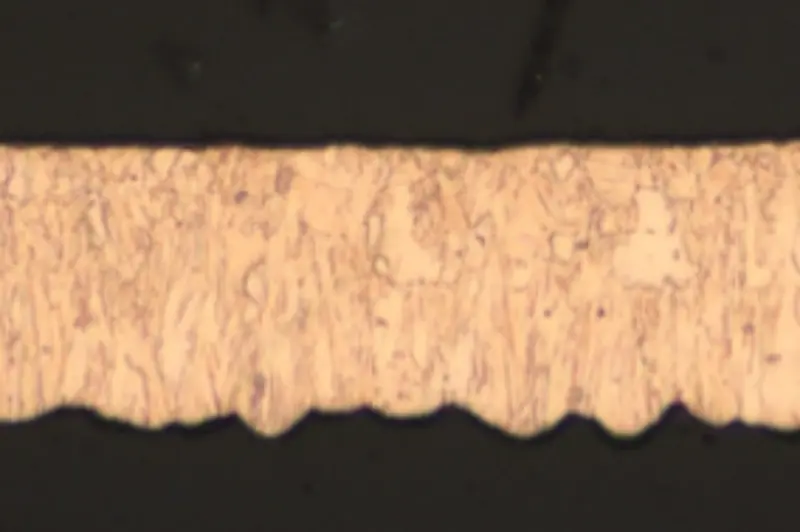
2. Stable columnar‑grain microstructure prevents thermal deformation during PCB fabrication
During PCB lamination and reflow soldering, ordinary copper foil suffers grain slip, resulting in board warpage and dimensional shift. Our RTF copper foil applies special electrolyte additive formulas to retain stable columnar grain structure even after high‑temperature annealing. It suppresses lattice slip and maintains mechanical strength under thermal cycles, securing dimensional stability for finished copper‑clad laminates.
3. Optimized anti‑undercut etching performance for HDI fine‑line production
Excessive side‑etching will shrink trace width and cause yield loss for high‑density PCB. HSMetal RTF copper foil features refined copper crystal grain control, restraining side‑etching during etching procedures. Verified by customer production lines, it delivers intact trace profiles and supports HDI and fine‑circuit manufacturing without yield drop.
4. Balanced low‑roughness & high peel‑strength
A common industry pain point: lower roughness usually sacrifices bonding force with resin substrate. Our high‑speed RTF achieves typical peel strength of 4.8 lb/in (≥4.0 lb/in as minimum spec). It maintains reliable adhesion performance even with low‑profile surface, avoiding delamination risks in multilayer high‑speed boards.
RTF vs. HVLP: Which Copper Foil is Right for Your AI Server Design?
When engineers design AI server PCBs (such as PCIe Gen5 platforms), they face a choice: RTF or HVLP (Hyper Very Low Profile). Both are low-loss materials, but they serve different purposes in a PCB stackup.
| Feature | High-Speed RTF Copper Foil | HVLP Copper Foil |
|---|---|---|
| Surface Roughness (Rz) | ≤ 2.1 μm (Typical 1.85 μm) | Extremely low, typically < 1.0 μm |
| Peel Strength | ≥ 4.0 lb/in (Typical 4.8 lb/in) | Lower (Due to ultra-smooth surface) |
| Signal Layer Application | Ideal for Inner-layer signal routing, high-speed backplanes, and general high-frequency environments | Required for ultra-high-speed outer layers and mmWave frequencies |
| Processability & Yield | Excellent adhesion, highly resistant to delamination during drilling and pressing | Requires strict control of lamination parameters to prevent separation |
| Cost-Effectiveness | Highly cost-effective for high-volume AI server production | Premium pricing due to complex manufacturing |
| Best Use Case | PCIe Gen5 servers, 5G base stations, data centers, high-speed switches (Inner layers) | AI accelerators, 112G/224G PAM4 channels, 800G optical modules (Outer layers) |
The Key Insight: Not every layer in an AI server requires the extreme (and expensive) smoothness of HVLP. High-speed RTF provides the perfect balance-it delivers sufficiently low insertion loss for high-speed signal layers while maintaining the high peel strength required to survive high-temperature pressing and drilling. It is the "workhorse" material that makes high-end AI servers commercially viable.
👉 Send your specification for a quotation
Application Fields
HSMetal's High-Speed RTF Copper Foil is specifically designed for the most demanding signal integrity applications:
- AI Servers & Data Centers: Designed for PCIe Gen5 platforms (e.g., Intel Eagle Stream, AMD Genoa).
- High-Speed Switches & Routers: Inner-layer signal routing for 400G/800G networking equipment.
- 5G Base Stations: High-frequency communication boards requiring stable signal transmission.
- High-Layer-Count Backplanes: Where high peel strength and thermal stability are crucial for reliability.
(Looking for the next generation of ultra-low-loss materials for outer layers? Explore our HVLP Copper Foil for AI Servers, with samples currently available for customer validation.)
Upgrade Your AI Server PCBs with Proven High-Speed RTF
Don't let signal loss limit your server's performance. HS Metal's mass-produced High-Speed RTF Copper Foil provides the reliable, low-loss, and high-adhesion solution your high-speed boards demand.
Send us your requirements today:
- Required thickness (e.g., 1 oz / 35 μm)
- Target application (PCIe Gen5, switch, HDI, etc.)
- Width and roll dimensions
- Estimated annual volume
Our technical team will review your stackup and provide a tailored recommendation, technical datasheets, and sample availability.
👉 Request Quotation For High-Speed RTF Copper Foil
FAQ
Q1: What does RTF mean in copper foil?
A: RTF stands for Reverse-Treated Foil. It is an electrodeposited copper foil that uses a reverse-side surface treatment process to create a controlled bonding surface for PCB laminate applications.
Q2: What is the main advantage of High-Speed RTF Copper Foil?
A: Its main advantage is the balance between a controlled, relatively low-profile copper surface and suitable resin bonding performance. This makes it a candidate for high-speed PCB applications where both electrical performance and manufacturing reliability matter.
Q3: What is the difference between RTF and HVLP copper foil?
A: RTF uses reverse surface treatment to balance surface profile and bonding performance, while HVLP is designed to achieve an ultra-low surface profile. HVLP generally has an advantage in applications with more demanding roughness-related conductor-loss requirements. RTF may offer a more cost-effective option when its qualified performance meets the PCB design requirements.
Q4: Is RTF copper foil suitable for AI server PCBs?
A: RTF copper foil can be considered for selected AI server PCB layers when its surface roughness, peel strength, and electrical performance meet the design requirements. The appropriate grade should be confirmed through laminate compatibility and electrical testing.
Q5: What is High-Speed RTF Copper Foil?
A: High-Speed RTF (Reverse Treated Foil) Copper Foil is a premium electrodeposited copper foil engineered for high-frequency and high-speed PCB signal layers. Unlike standard foil, RTF features a special treatment where the smooth drum side is used for signal transmission, while the roughened treated side provides strong adhesion to the dielectric. The "High-Speed" variant specifically controls surface roughness (Rz ≤ 2.1 μm) and enhances the crystal structure to minimize signal loss and ensure dimensional stability in high-temperature lamination.
Q6: Is RTF copper foil cheaper than HVLP copper foil?
A: RTF is generally positioned as a more cost-conscious option than advanced HVLP grades, but actual pricing depends on product grade, copper thickness, surface treatment, order quantity, and supplier. Buyers should compare quotations for technically equivalent requirements.
Q7: Can RTF copper foil provide sufficient peel strength for multilayer PCBs?
A: RTF copper foil is designed with a treated bonding surface to support adhesion to dielectric resin systems. Actual peel strength depends on the foil grade, resin formulation, lamination conditions, and test method. Buyers should review the technical data and conduct qualification testing with their own laminate system.
Q8: What does "Reverse Treated" (RTF) actually mean?
A: In standard copper foil, the rough side is usually the shiny drum side. In RTF, the process is "reversed." A special roughening treatment is applied to one side (the matte side) to ensure high peel strength with the resin, while the other side (the drum side) remains ultra-smooth to carry the high-frequency signal. This prevents the skin effect from scattering the signal across a bumpy surface.
Q9: Can RTF copper foil be used with high-speed laminate materials?
A: It may be suitable for selected high-speed laminate systems, including modified FR-4, hydrocarbon-based, and PPE/PPO-based materials. Compatibility should be confirmed using the specific resin system and the manufacturer's technical data.
Q10: How can PCB manufacturers select the right RTF copper foil grade?
A: Buyers should compare surface roughness, peel strength, copper thickness, tensile strength, elongation, and compatibility with the intended laminate. Signal frequency and insertion-loss targets should also be considered when choosing between RTF and HVLP.
Q11: Why should I choose High-Speed RTF instead of standard RTF for AI servers?
A: Standard RTF has a rougher surface (higher Rz), which causes excessive insertion loss at high frequencies. Our High-Speed RTF controls Rz to ≤ 2.1 μm (typical 1.85 μm), significantly reducing the skin effect and enabling stable signal transmission for PCIe Gen5 and 800G applications.
Q12: Can I use High-Speed RTF for the outer layers of my PCB?
A: High-Speed RTF is highly recommended for inner-layer signal routing and high-speed backplanes. For the outermost layers where line widths are extremely fine and frequencies are absolute highest (e.g., 112G/224G PAM4 channels), you may want to consider an ultra-low-loss material like HVLP Copper Foil for AI Servers.
Q13: How does this RTF foil prevent PCB warpage during high-temperature pressing?
A: HS Metal uses a special additive formula that allows the copper foil to maintain its columnar crystal structure after annealing. This suppresses lattice slip at high temperatures, preserving the dimensional stability of the CCL (Copper Clad Laminate) and preventing board warpage.
Q14: What is the peel strength of your High-Speed RTF foil?
A: Our High-Speed RTF foil achieves a typical peel strength of 4.8 lb/in, which is well above the industry baseline of ≥4.0 lb/in. This guarantees excellent adhesion and prevents delamination during drilling and assembly.
Q15: How does it perform during fine-line HDI etching?
A: We use a micro-copper crystallization treatment that enhances etchability. This significantly suppresses "side etching" (where the sides of the circuit trace are eaten away), ensuring the integrity and precise dimensions of fine-line HDI circuits.


