


Brass Tube Used For Telescopic Antennas is not a single standard grade, but refers to precision thin-walled drawn tubes made of brass with high zinc content such as H63, H65, H68, C2680, C2720, etc. The core requirements are high ductility, extremely strict dimensional tolerances (usually ± 0.01mm level), uniform wall thickness (usually ≤ 0.2mm), and extremely high surface smoothness to ensure smooth sliding and stable conductivity of multiple nested sections.
Technical Requirements
The Brass Tube Used For Telescopic Antennas normally should be achieve below basic requirements
- High ductility – to endure repeated extension/retraction cycles without cracking;
- Extremely tight dimensional tolerances – typically held within ±0.01 mm to guarantee accurate nesting between sections;
- Uniform wall thickness – often required to be ≤0.2 mm to minimise weight while maintaining structural integrity;
- Superior surface finish – to reduce friction, enable smooth telescoping motion, and ensure stable electrical conductivity throughout the antenna's service life.
Below is one of our Sri Lanka Customer's purchase requirements about Antenna Brass Tube
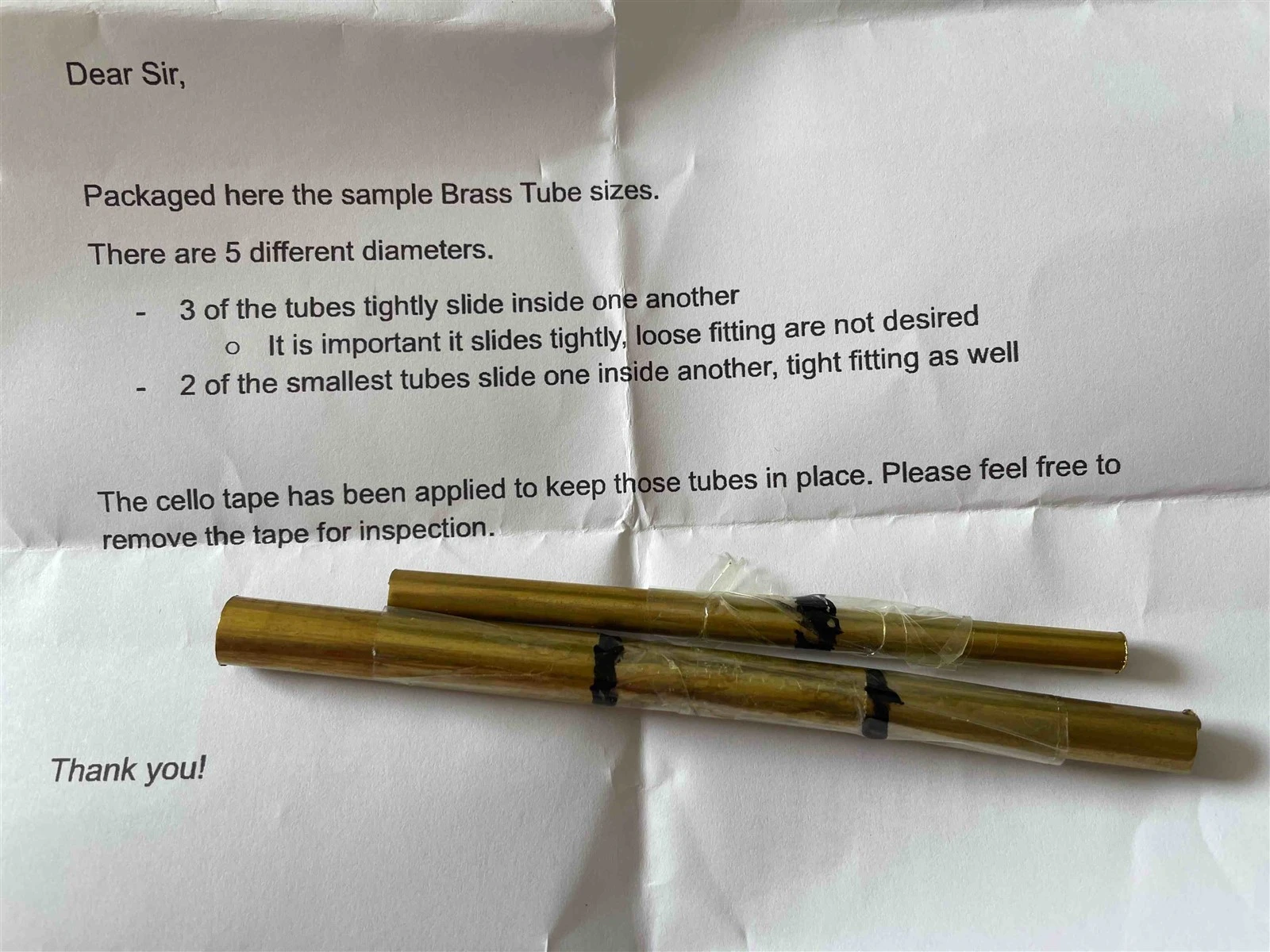
Key materials and specification features
- Commonly used grades: H63/H65/H68 (with moderate zinc content, balancing strength and deep drawing/drawing performance) or American standard C2680 is preferred; H62 is less commonly used for multi section precision nested antennas due to its slightly higher hardness and lower ductility, and is more commonly used for fixing connectors.
- Process requirements: Cold drawing technology must be used for production to ensure smooth inner walls without burrs, outer diameter tolerances controlled within IT7-IT8 levels, and wall thickness typically controlled between 0.1mm-0.3mm to achieve lightweight and multi section storage.
- Performance indicators: It is required to have excellent conductivity (relative to copper>60% IACS), fatigue resistance (repeated expansion and contraction without loosening or deformation), and corrosion resistance (often requiring passivation or tin plating treatment)
Why Brass Instead of Copper?
Our client initially considered pure copper tubing for their antenna project, given its exceptionally high electrical conductivity (approximately 58 MS/m), which makes it an ideal conductor. However, upon deeper analysis, we recognized that for the specific application of telescopic antennas, conductivity alone does not dictate material selection.
The primary operational demand of telescopic antennas involves repeated extension and retraction cycles, placing greater emphasis on mechanical strength and wear resistance. While brass exhibits lower conductivity than copper (in the range of 15–28 MS/m), it offers superior mechanical properties, better machinability, and improved weldability. More importantly, brass is harder than copper, enabling it to withstand the structural stresses imposed by repeated sliding and insertion cycles.
Consequently, we narrowed our focus to the standard brass series and initiated a systematic comparison across grades such as H62, H63, and H65.
H63 vs. H65 – How to Choose?
The main difference lies in copper content and resulting performance emphasis.
| Characteristic | H63 Brass | H65 Brass |
|---|---|---|
| Copper content | 62.0% – 65.0% | 63.5% – 68.0% |
| Core performance | High cost‑effectiveness; properties between H68 and H62 | Superior overall performance with higher strength and ductility |
| Workability | Good for both cold and hot forming | Even better cold and hot pressure processing |
| Corrosion resistance | Stable against general corrosion but prone to stress corrosion cracking | Better corrosion resistance |
| Typical applications | Hardware, screws, washers, shallow‑drawn parts | Electrical components, connectors, radiators, more demanding parts |
| Cost | Lower | Higher |
Summary: For cost‑sensitive projects where extreme performance is not required, H63 Brass Tube Used For Telescopic Antennas is the more economical choice. If your antenna demands higher strength, corrosion resistance, or complex forming, and budget allows, H65 is preferable.
H63 Brass Tube Used For Telescopic Antennas
For telescopic antenna applications, H63 brass is a cost‑effective and well‑balanced choice. Compared to the H65 grade mentioned earlier, it is more economical while still meeting most basic antenna requirements.
What is H63 Brass?
H63 is a common grade of ordinary brass under the Chinese national standard (GB). The "H" stands for brass, and "63" indicates a nominal copper content of about 63%.
Chemical composition: Mainly copper (Cu) 62.0% – 65.0% and the balance zinc (Zn).
Key characteristics: Good mechanical properties, good cold and hot workability, good machinability, and easy to weld and braze.
Application selection precautions
- Sliding fit accuracy: A dynamic fit gap of 0.02mm-0.05mm should be reserved between the outer and inner diameters of adjacent pipe sections. If it is too large, it will cause poor shaking contact, and if it is too small, it will get stuck and unable to expand or contract.
- Alternative trend: Due to cost and weight considerations, modern portable devices are increasingly using 304/316 stainless steel thin-walled tubes instead of brass. However, brass still has advantages in RF conductivity and damping feel.
- Key identification points: High quality antenna brass tube with uniform golden color, no cracks in bending test, smooth multi section stretching without "step feeling"; Poor quality products are prone to drawing patterns and uneven wall thickness, leading to sticking.
This type of pipe belongs to special precision copper processing materials. When purchasing, it is necessary to clearly label "rod antenna special", "cold drawn precision pipe" and specific tolerance levels. Ordinary building or refrigeration brass pipes cannot meet the nested sliding requirements
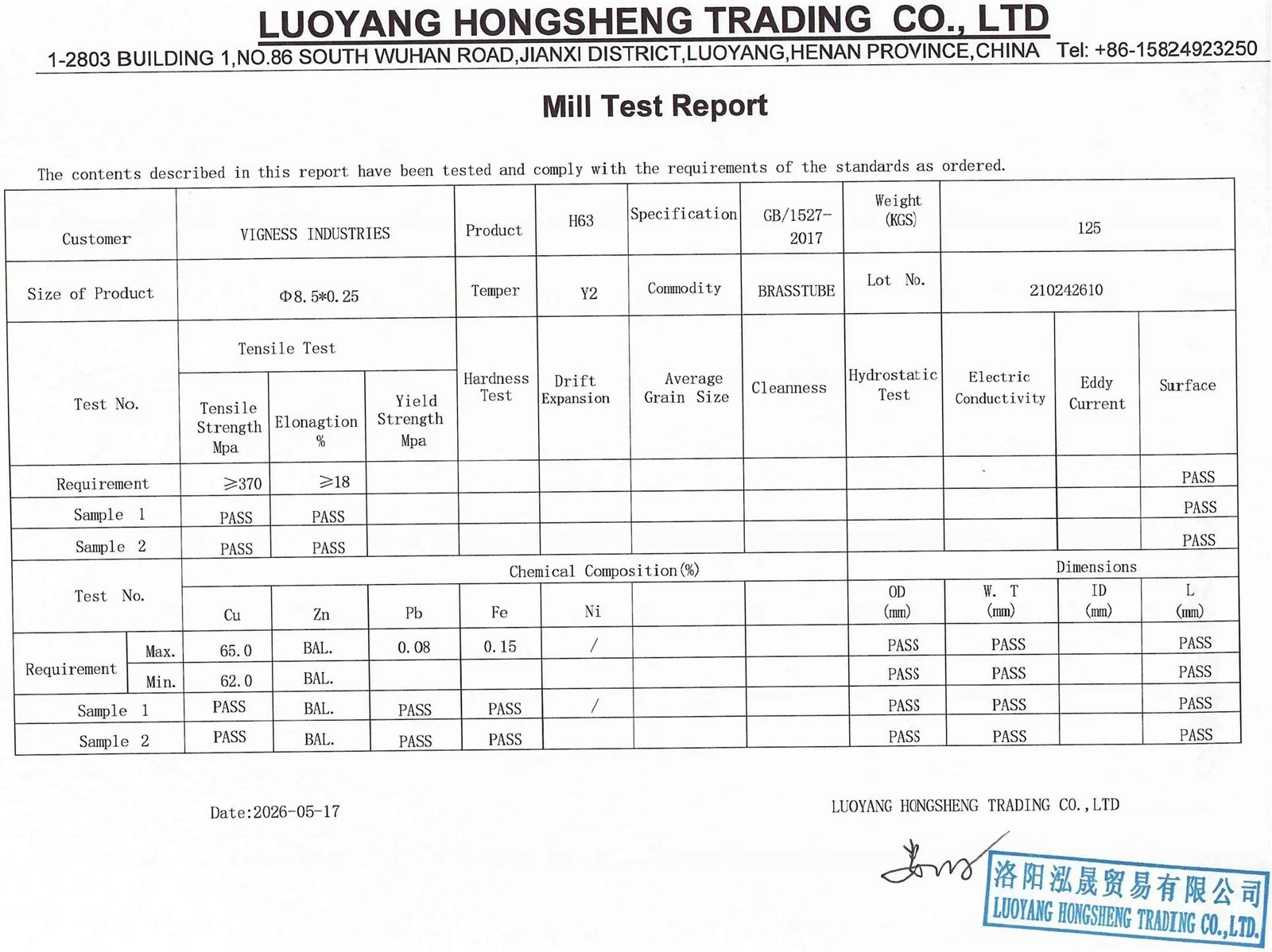
Brass Tube test report
The Test Report for the Brass Tube that we supplied to Customers

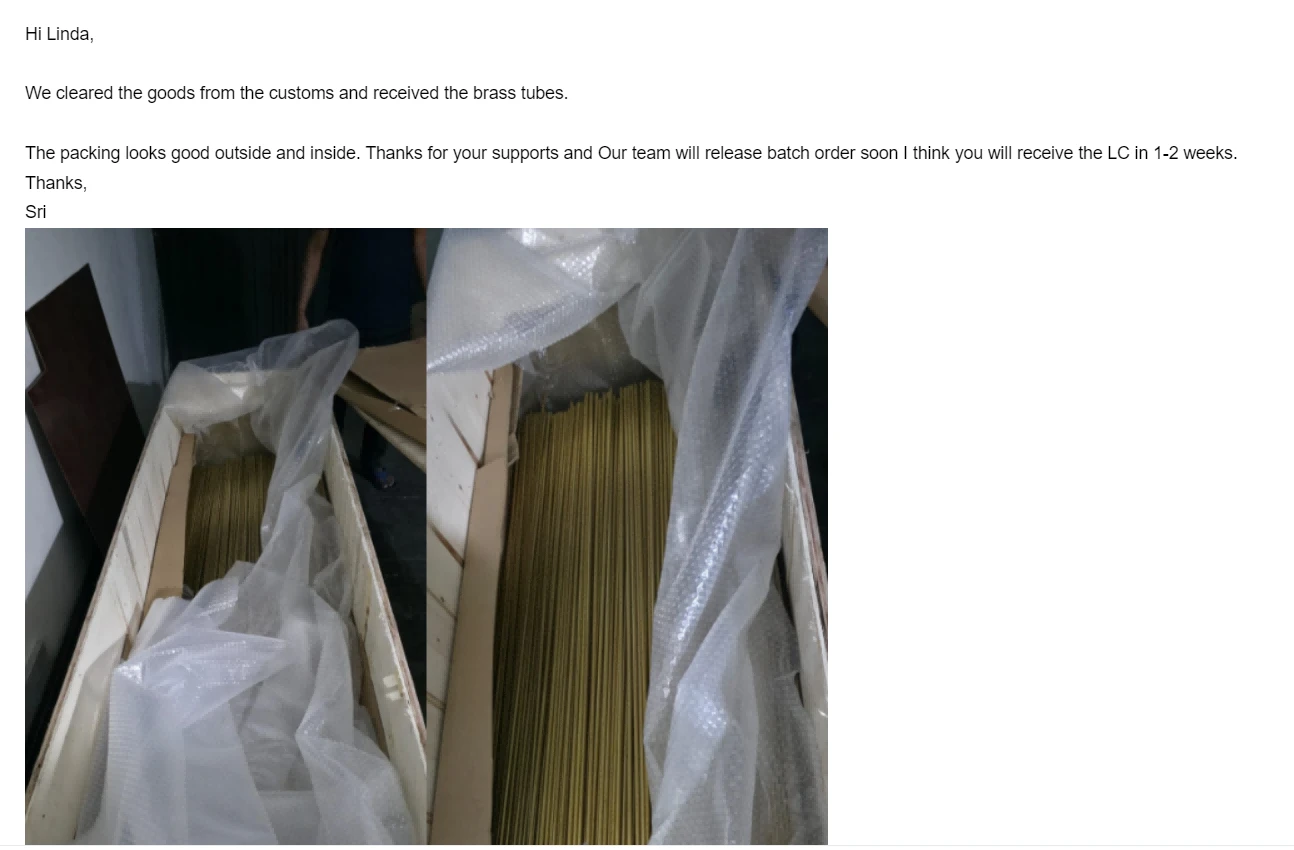
Product Packages


Customer Feedback
About US
Luoyang Hongsheng Trading Co., Ltd. is a professional metal material supplier located in Luoyang, Henan Province, an important heavy industrial city in China. We are committed to becoming an innovation driven supplier of metal material solutions. The company integrates R&D, production, sales, and technical support, providing high-quality copper products, precision alloys, high-temperature alloys, corrosion-resistant alloys, titanium alloys etc. to customers worldwide. Through close technical collaboration with multiple non-ferrous metal research institutes and universities in Luoyang, we provides scientific material solutions and high-quality product services to domestic and foreign customers. Our products are exported to more than 20 countries and regions including the United States, the European Union, Asia, and Africa. We have established long-term strategic partnerships with Pakistani customers, and Pakistan's tender projects standing as a significant part of our business.
The company's core products are high-quality copper-based materials such as copper tubes, copper rods, copper foils, and copper plates, as well as various alloy tubes, rods, plates, and other substrates. available in thousands of grades and tens of thousands of specifications. The products are widely used in various fields such as aerospace, civil nuclear power, oil & gas pipelines, HVAC and home appliances, industrial equipment, marine engineering, power generation, photovoltaics, wind power, semiconductors, 5G communications, and new energy sectors.etc.
In recent years, the company has continuously optimized the the product structure of the enterprise to better satisfy customer requirements and expand our business coverage. Our R&D team is constantly striving to keep up with industry trends. On the basis of the original copper foil,we have independently developed high-performance carbon-coated copper foils for overseas lithium battery manufacturers and academic institutions. This material effectively improves the adhesion of electrode active materials and enhances battery energy efficiency which have been gained recognition from internationally renowned lithium battery manufacturers and the University of Southampton alreaday.
Our company consistently adheres to the philosophy of "Technological Innovation, Quality Assurance, Excellent Service, and Integrity-Based Operations," dedicated to providing global customers with superior products and professional technical services.
Production And Testing Equipments

Brass Finishing Equipment

Copper Drawbench

Rolling Mill Equipment

Rotating+Passing Eddy Current Flaw Detector

Electron Microscope

German Spike Spectral Analyzer
FAQ
Q1:What information should i confirm you when i send inquiry?
A:Sometimes we need product specification like material standard or Grade, size, Qty, shipping port, Terms like FOB or CIF etc.
Q2: Why brass instead of pure copper for telescopic antennas?
A: While pure copper offers higher electrical conductivity (~58 MS/m), telescopic antennas demand more than just conductivity. The core requirement is repeated extension and retraction cycles, which place greater emphasis on mechanical strength and wear resistance. Brass provides superior mechanical properties, better machinability, improved weldability, and greater hardness to withstand structural stress from repeated sliding. Although brass has lower conductivity (15–28 MS/m), this trade-off is well accepted in antenna applications where mechanical durability is critical
Q3: What brass grades are commonly used for telescopic antennas?
A: Common grades include H63, H65, H68 (Chinese GB standard) and C2680, C2720 (international equivalents). These medium-to-high zinc brasses are precision-drawn into thin-wall tubing with diameters typically ranging from 2.5 mm to 6 mm. H63 is often the preferred choice for its optimal balance of performance, processability, and cost-effectiveness.
Q4: How do H63 and H65 compare?
A: H65 offers slightly higher copper content (63.5–68.0%) and superior overall performance, while H63 (62.0–65.0% copper) provides better cost-effectiveness. For most telescopic antenna applications where extreme performance is not required, H63 is the more economical choice that still meets all critical mechanical and electrical requirements.
Q5: What is the typical wall thickness for telescopic antenna tubes?
A: Wall thickness generally ranges from 0.14 mm to 0.25 mm. Some applications may require thickness up to 0.6 mm depending on the specific design and mechanical requirements.
Q6: How many sections typically comprise a telescopic antenna?
A: A telescopic antenna is generally composed of 2 to 4 sections of progressively smaller diameters that nest and slide within one another.
Q7: Are there alternatives to brass for antenna tubes?
A: Yes, alternatives include:Aluminum – lighter weight, suitable for larger antennas as well as Stainless steel – good strength and corrosion resistance, weldable.However, for telescopic applications requiring thin walls and smooth sliding, brass remains the preferred choice due to its combination of mechanical properties, machinability, and cost-effectiveness
Q8: How long of the delivery time?
A: Usually, the shipment can be delivery within 15-30days after the order confirmed.
Q9: How about the payment items?
A: LC, T/T, PayPal, Western Union etc.
Q10: Which country have you exported to?
A: Our main market is South America, Middle East, Africa and Europe. And have built long time relationship with Pakistan, US, Norway, Germany, Korea, Russia,Taiwan customers.And got continue orders from them every month.
Q11: How about the MOQ?
A: Normally MOQ is 200kg, We always expect more opportunities with you. But for some special material or special size let's communicate the actual status.
Hot Tags: H63 Brass Tube Used For Telescopic Antennas, China H63 Brass Tube Used For Telescopic Antennas manufacturers


